
Mold and Indoor Air Quality in San Francisco: The Complete 2026 Guide

What if the iconic San Francisco fog isn't just a scenic backdrop, but a silent catalyst for the persistent musty scent lingering in your Sunset District Victorian? Living in the Bay Area means embracing a unique relationship with moisture, yet many residents struggle to find the balance between coastal charm and healthy living. When it comes to mold and indoor air quality san francisco property owners often find that standard cleaning isn't enough to combat the microscopic spores thriving in our specific microclimates. You've likely noticed that certain rooms feel perpetually damp or that health symptoms like asthma seem to worsen the moment you settle in for the evening.
We understand how frustrating it is to feel uneasy in your own home, especially when you're unsure if a general contractor or a specialized expert is needed. This guide will help you discover how our city's coastal climate impacts your breathing air and outline the professional standards for a truly healthy environment. You'll gain a clear checklist for evaluating specialists and the scientific knowledge required to ensure your home remains a safe, pure sanctuary for your family and pets.
Key Takeaways
- Understand how San Francisco's persistent marine layer maintains humidity levels above 60%, creating a unique challenge for residential building health.
- Learn the clinical mechanics of how mold spores and mycotoxins infiltrate indoor environments and impact your family's systemic wellness.
- Identify the specialized equipment, such as infrared cameras and particle counters, required for an accurate assessment of mold and indoor air quality san francisco.
- Gain actionable insights into moisture control and ventilation strategies tailored to the architectural nuances of historic Bay Area homes.
- Discover how non-invasive remediation methods can restore air purity and safety without the disruption of traditional construction or demolition.
Understanding the Link Between Mold and IAQ in San Francisco
Indoor Air Quality, or IAQ, refers to the healthfulness of the air within and around buildings. When we analyze mold and indoor air quality san francisco, we focus specifically on bioaerosols. These are airborne particles that include living organisms like mold spores, bacteria, and their metabolic byproducts. High concentrations of these particles can compromise the respiratory health of occupants, especially in a city where the outdoor environment is often saturated with moisture.
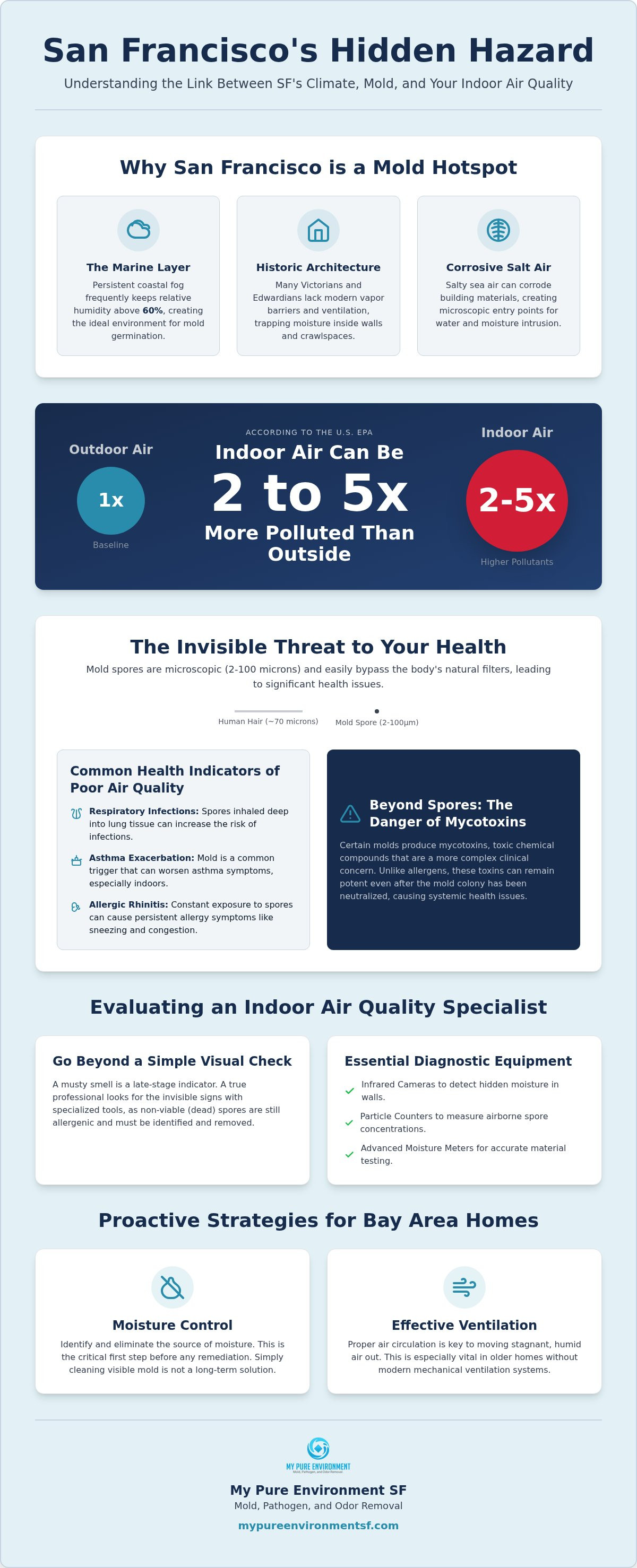
The U.S. Environmental Protection Agency reports that indoor air quality can be two to five times more polluted than the air outside. This statistic is particularly relevant for residents of San Francisco's historic Victorians and Edwardians. These structures often lack the modern vapor barriers and mechanical ventilation systems required to move stagnant air. Without proper circulation, moisture becomes trapped within wall cavities and crawlspaces, turning architectural gems into breeding grounds for fungal colonies.
The SF Climate Factor: Why Our City is a Mold Hotspot
San Francisco’s geography creates a constant battle against the "marine layer." This thick coastal fog maintains a relative humidity level that frequently exceeds 60%, providing the ideal baseline for mold germination. The risk varies significantly by neighborhood. Residents in the Sunset or Richmond districts experience higher moisture loads than those in the Mission, where warmer temperatures might seem safer but can actually accelerate growth if moisture is present.
Coastal salt air also plays a role, as it can be corrosive to building envelopes, creating tiny breaches where water can enter. The dew point in a San Francisco home is the specific temperature at which the air becomes saturated and water vapor condenses into liquid droplets on cool surfaces, often triggering hidden mold growth behind furniture or inside closets.
IAQ Beyond the Smell: Invisible Spores
Many property owners assume their air is safe if they don't detect a pungent, earthy odor. However, a lack of "musty smell" doesn't guarantee purity. High counts of non-viable spores, which are dead but still contain allergenic proteins, can trigger health symptoms just as easily as living, viable spores. These particulates remain light enough to stay suspended in the breathing zone for extended periods.
In multi-unit San Francisco apartments, shared HVAC systems can inadvertently circulate these contaminants between units. For a comprehensive overview of indoor mold, one must understand that spores are often invisible to the naked eye. Improving mold and indoor air quality san francisco requires looking past surface aesthetics and utilizing clinical testing to identify what's actually lingering in the air you breathe every day.
The Invisible Threat: How Mold Spores Compromise Your Air
Mold spores are exceptionally small, often ranging from 2 to 100 microns in size. Because they are invisible to the naked eye, they easily bypass the body's natural filters in the nose and throat. Once inhaled, these microscopic particles can travel deep into the lung tissue; in some cases, they can even cross the alveolar membrane into the bloodstream. The World Health Organization (WHO) guidelines on dampness and mold conclude that there is a direct correlation between these indoor contaminants and an increased risk of respiratory infections, asthma exacerbation, and allergic rhinitis.
Beyond the physical spores, the presence of mycotoxins presents a more complex clinical concern. These toxic chemical compounds are produced by certain fungal species as a defense mechanism. Unlike simple allergens, mycotoxins can remain potent even after the mold itself has been neutralized. In the unique urban landscape of the Bay Area, these bioaerosols often synergize with other pollutants. During wildfire season, the influx of particulate matter can act as a vehicle, carrying mold spores and urban dust deeper into the home's interior and compromising the mold and indoor air quality san francisco residents expect.
Common Health Indicators of Poor Air Quality
Distinguishing between seasonal allergies and mold-related illness is a vital step for residents. While pollen allergies typically fluctuate with the seasons, mold symptoms often remain constant or worsen specifically when you are indoors. Some individuals may develop Chronic Inflammatory Response Syndrome (CIRS), a systemic inflammatory condition caused by an inability to clear biotoxins. This condition requires a clinical approach to remediation that goes beyond simple cleaning. Vulnerable family members and pets often exhibit symptoms first, as their smaller lung capacities and proximity to floor-level dust make them more susceptible to poor mold and indoor air quality san francisco.
Hidden Mold: Attics and Bathrooms
In many San Francisco properties, the most significant air quality threats are hidden from view. Attic mold is frequently discovered during real estate transactions, often resulting from improper bathroom fan venting or small roof leaks that go unnoticed. These areas are connected to your living space through the "Stack Effect." As warm air rises and exits through the attic, it creates a pressure differential that pulls air from lower levels and wall cavities upward. This means contaminants in a crawlspace or attic eventually circulate through your main living areas. Following EPA guidelines on mold is a good starting point for moisture control, but specialized detection is often necessary. If you suspect an issue, reviewing our San Francisco Mold Testing Guide for Property Owners can provide a roadmap for professional assessment. Restoring your home's health begins with a thorough indoor air quality improvement strategy that addresses these hidden reservoirs.
Evaluating Indoor Air Quality Companies in SF: A Checklist
Selecting a partner to manage your home's environmental health requires looking beyond general contractor licenses. In the complex ecosystem of mold and indoor air quality san francisco, technical precision is non-negotiable. A professional IAQ consultation shouldn't be a mere visual walkthrough; it must be a data-driven assessment that utilizes specialized instrumentation to identify hidden risks. You should expect your specialist to use infrared cameras to detect thermal anomalies behind walls, particle counters to measure airborne debris, and moisture meters to verify the structural integrity of building materials.
When you receive your results, the data should come from an independent, lab-certified facility. Ask your provider how they interpret these findings. A clinical approach focuses on the systemic health of the building rather than just visible patches of growth. If a company cannot explain the difference between viable and non-viable spore counts in your specific report, they likely lack the specialized training required for high-level air purity work.
Specialist vs. Generalist: Why it Matters
Many firms in the Bay Area operate as general "water damage restoration" companies. While these businesses are equipped for emergency flood response, they often lack the clinical focus needed for long-term air quality improvement. There's also a significant risk of a conflict of interest when a company performs the initial assessment and then profits from extensive rebuilding and construction. My Pure Environment SF maintains a strict focus on the science of the air. We avoid general construction and rebuilding to ensure our testing remains objective and health-centric. When vetting providers, look for certifications from the IICRC or the American Council for Accredited Certification (ACAC), which indicate a commitment to industry-standard protocols.
Local Knowledge and Compliance
San Francisco's regulatory landscape is unique. Under the San Francisco Health Code, Article 11, §581, mold is defined as a public health nuisance. The San Francisco Department of Public Health (SFDPH) can enforce remediation based on "otherwise demonstrable" evidence, such as professional air testing, even if mold isn't visible to the naked eye. Local experts understand this "Standard of Care" better than national chains. They recognize that California Civil Code § 1941.1 requires landlords to provide a dwelling free from dampness and visible mold to be considered habitable.
This local expertise is especially critical in San Francisco’s specialized markets, such as cannabis facilities. These high-compliance environments require rigorous IAQ standards to prevent crop loss and maintain safety. Whether you're a property manager or a homeowner, ensuring your provider understands these specific local mandates is the only way to guarantee your mold and indoor air quality san francisco meets 2026 safety benchmarks.
Beyond Remediation: Proactive IAQ Strategies for SF Homes
Maintaining a healthy living environment requires a shift from reactive cleaning to proactive environmental management. In our coastal landscape, moisture control is the essential foundation for long-term air purity. While HEPA filtration is effective at capturing larger particulates, it's often insufficient for addressing the root cause of fungal growth. Filters can trap floating spores, but they won't stop a colony from expanding behind a wall or under a floorboard. Ensuring superior mold and indoor air quality san francisco requires a more systemic view of the home's ecosystem.
Professional maintenance involves a multi-step approach to air health:
- Moisture Control: Maintaining consistent humidity levels to prevent spore germination.
- Ventilation: Implementing strategies to move stagnant air in older building envelopes.
- Regular IAQ Testing: Establishing a baseline and monitoring for shifts in spore concentrations.
- Advanced Filtration: Using HEPA technology to manage particulates while addressing the source.
- Clinical Sanitization: Utilizing non-invasive methods to neutralize contaminants without demolition.
Consistent data collection is the only way to verify that your mold and indoor air quality san francisco remains within safe parameters year-round. This proactive stance prevents minor moisture issues from becoming systemic health hazards.
Managing Humidity in the Fog City
San Francisco residences require precise humidity management to combat the persistent marine layer. We recommend maintaining indoor relative humidity between 30% and 50%. Settings higher than 60% provide the moisture necessary for mold to thrive. Identifying "cold spots" is equally critical. These are areas where poor insulation meets cold outdoor air, often on the corners of exterior walls or behind heavy furniture. When warm indoor air hits these surfaces, condensation forms, creating a micro-environment for mold. For bathrooms without exterior windows, using high-efficiency exhaust fans with timers is essential to ensure moisture is fully evacuated.
The Non-Invasive Advantage
Traditional remediation often involves invasive demolition, which can inadvertently release millions of spores into the breathing zone during the process. We utilize advanced "Dry Fog" technology to sanitize the entire building volume without tearing down walls. This method uses a micron-sized mist that penetrates porous surfaces and reaches hidden spores in wall cavities and ventilation ducts. Avoiding demolition preserves the structural integrity of your home while preventing the cross-contamination often associated with standard construction. This sophisticated method ensures that your living space is restored to a clinical standard of purity. For a deeper look at our methodology, read about Professional Mold Remediation in San Francisco: A Science-Based Approach. If you're concerned about the air in your property, we recommend scheduling a professional mold testing & inspection to establish a clear baseline for your indoor health.
The My Pure Environment SF Approach to Total Air Purity
At My Pure Environment SF, we believe that restoring a building's health requires more than just removing visible growth. Our methodology combines clinical-grade mold and indoor air quality san francisco testing with advanced, non-invasive remediation. This integrated approach ensures that every project begins with a precise diagnostic phase, followed by a targeted treatment that addresses the entire interior volume. We don't just "patch a leak" or clean a surface; we focus on the systemic health of the environment to provide long-term protection. This is the core of our "Pure Air" philosophy, ensuring that the air you breathe is free from both viable and non-viable contaminants.
Our commitment to the San Francisco community extends to both residential properties and high-compliance cannabis facilities. In these sensitive environments, maintaining air purity is critical for both human health and product integrity. We provide property owners with transparent, easy-to-read reports that translate complex lab data into actionable insights. By providing this level of detail, we ensure you have complete confidence in the safety of your space for your family, pets, or employees. Our goal is to act as a protective guide, helping you navigate environmental concerns with scientific accuracy.
Why SF Property Managers Trust Our Specialized IAQ Services
Property managers in the Bay Area face unique challenges, particularly with the city's aging housing stock and strict habitability laws. Recurring mold issues in rentals often stem from underlying moisture patterns that standard cleaning fails to resolve. In one instance, we helped a local landlord address a persistent issue in a multi-unit Edwardian building where previous contractors had failed. By utilizing our non-disruptive dry fog technology, we neutralized spores throughout the building without requiring tenants to move out or endure weeks of demolition. This process provides lab-backed proof of air purity, which is essential for legal compliance and tenant peace of mind. Our specialized mold and indoor air quality san francisco services allow managers to maintain their properties without the friction of major construction or long-term displacement.
Taking the Next Step Toward Cleaner Air
Restoring your home's air quality doesn't have to be a stressful or destructive process. When you book a professional assessment with our SF team, we start with a thorough investigation of your property's micro-climate and structural health. During the initial visit, our specialists will use diagnostic tools to map moisture levels and collect air samples for independent laboratory analysis. We walk you through the findings and develop a customized plan to restore your environment to a clinical standard of cleanliness. This transparent process ensures you're informed at every stage of the narrative, moving at a pace that prioritizes understanding over a simple transaction.
If you're ready to secure the health of your home or business, Schedule your San Francisco Indoor Air Quality Assessment today.
Securing a Healthier Future for Your San Francisco Property
The persistent marine layer and historic architecture of the Bay Area create a unique environmental profile that requires a specialized approach. True mastery of mold and indoor air quality san francisco involves moving beyond surface-level cleaning to address the microscopic spores and mycotoxins that compromise your systemic health. By prioritizing moisture control and utilizing clinical testing, you can transform your home or workplace into a resilient sanctuary.
Our team of specialized SF-based experts is dedicated to this scientific standard. We utilize non-invasive dry fog technology to neutralize contaminants without the disruption and cross-contamination risks of traditional demolition. Every assessment is backed by lab-certified testing results, providing you with the transparent data needed for complete peace of mind. Whether you manage a historic rental or a high-compliance cannabis facility, your environment deserves a clinical level of care.
Breathe easier; book your professional IAQ and mold inspection in San Francisco today. You don't have to navigate these environmental challenges alone. We're here to help you restore the purity of your indoor air and protect the well-being of everyone inside.
Frequently Asked Questions
How do I know if I need mold testing or a full indoor air quality assessment?
You need mold testing if you observe visible growth or have a confirmed water leak. A full indoor air quality assessment is more appropriate if you're experiencing health symptoms like brain fog without an obvious source of moisture. The assessment evaluates a broader range of contaminants, including bioaerosols and particulates. This systemic view helps identify hidden threats that simple surface testing might miss in complex San Francisco environments. It's a proactive way to ensure overall safety.
Is mold common in San Francisco apartments due to the fog?
Yes, the persistent marine layer keeps relative humidity levels above 60% in many neighborhoods, which is the ideal threshold for spore germination. San Francisco's historic architecture often lacks modern vapor barriers, making apartments in the Sunset and Richmond districts particularly susceptible to dampness. This environmental baseline makes mold and indoor air quality san francisco a primary concern for local property owners who want to maintain a healthy and compliant living space for their residents.
What are the legal requirements for mold testing for SF landlords?
Under the San Francisco Health Code, Article 11, §581, mold is classified as a public health nuisance. Landlords are legally required to maintain habitable dwellings, which includes the absence of dampness and visible mold as per California Civil Code § 1941.1. While specific annual testing isn't mandated, landlords must remediate demonstrable evidence of mold once reported. Failure to address these issues can lead to formal complaints with the Department of Public Health or the Department of Building Inspection.
Can poor indoor air quality cause symptoms like brain fog or fatigue?
Clinical evidence suggests that exposure to mycotoxins and high concentrations of bioaerosols can trigger systemic inflammatory responses. These conditions often manifest as cognitive impairment, persistent fatigue, or unexplained respiratory distress. Because these microscopic particles can cross into the bloodstream, the impact is often systemic rather than localized. Addressing mold and indoor air quality san francisco is a vital step in resolving these chronic health indicators and restoring your daily wellness and cognitive clarity.
How long does a professional mold inspection take in a standard SF home?
A thorough inspection for a typical 1,500-square-foot home usually takes between two and four hours. This duration allows the specialist to perform a visual assessment, utilize infrared cameras for moisture mapping, and collect air or surface samples. The timeline may extend if the property has complex crawlspaces or attics. These areas require meticulous evaluation to ensure no hidden reservoirs are overlooked during the diagnostic phase of the process, ensuring a complete picture of your home's health.
What is the difference between an IAQ consultant and a mold remediator?
An IAQ consultant focuses on the detection and diagnostic phase, identifying the specific contaminants impacting the air. A mold remediator performs the actual removal and sanitization of those contaminants. Some firms bridge this gap by providing specialized testing and non-invasive remediation. This ensures the diagnostic data directly informs the restoration process. It avoids the conflict of interest often found in general construction companies that prioritize expensive rebuilding over the science of air purity.
Can I improve my air quality without tearing down my walls?
You can achieve clinical-grade air purity through non-invasive "Dry Fog" technology. This method uses a specialized mist to neutralize airborne and surface spores throughout the building volume, including hidden areas like wall cavities. It eliminates the need for destructive demolition, which often releases more contaminants into the air. This approach is faster and more cost-effective than traditional methods. It's an ideal solution for maintaining the structural integrity of historic San Francisco properties while ensuring safety.
How often should I have my indoor air quality tested in the Bay Area?
We recommend a professional assessment at least once a year, particularly before the winter rainy season begins. Annual testing establishes a health baseline for your property and allows for the early detection of moisture issues before they become systemic. Property managers of multi-unit buildings or owners of high-compliance cannabis facilities may require more frequent monitoring. This ensures they consistently meet 2026 safety and habitability standards while protecting the long-term value of their assets.
