
Commercial Mold Testing San Francisco: The 2026 Office Guide

Could the persistent respiratory issues circulating through your San Francisco office be more than just a seasonal cold? When employee absenteeism rises and the source of the discomfort remains hidden, the culprit is often found in the building's systemic health. Maintaining a productive workplace in the Bay Area requires more than just a clean desk; it demands precision in managing indoor air quality. That's why professional commercial mold testing san francisco has become a vital standard for modern businesses facing our unique coastal humidity and aging building stock.
It's understandable to feel concerned about the potential for expensive disruptions or the confusion regarding landlord versus tenant responsibilities. You shouldn't have to choose between a healthy environment and a functioning office. This guide provides a clear roadmap to identify workplace pollutants and understand the specific air quality challenges facing San Francisco properties in 2026. We'll show you how to choose a non-invasive testing partner to verify your office meets health and safety standards without the need for tearing down walls.
Key Takeaways
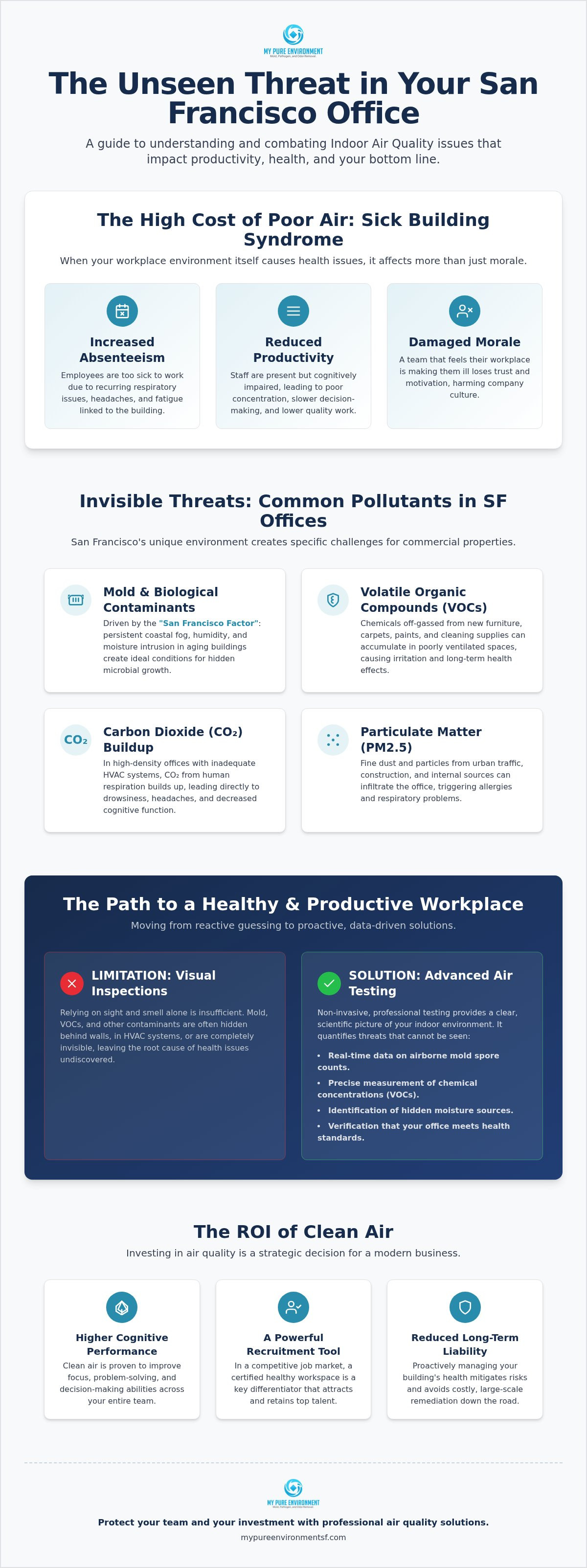
- Learn how "Sick Building Syndrome" impacts your bottom line through absenteeism and discover the true financial cost of poor indoor air quality.
- Identify hidden office pollutants like VOCs from new furniture and CO2 buildup that often go unnoticed in high-density San Francisco workspaces.
- Understand why visual inspections are insufficient and how advanced commercial mold testing san francisco provides real-time data on spore counts and chemical concentrations.
- Gain a step-by-step roadmap for documenting employee health patterns and reviewing HVAC maintenance to proactively manage building health.
- Discover how non-invasive testing and remediation can protect your team's safety without the need for disruptive wall demolition or construction.
The Impact of Indoor Air Quality on San Francisco Office Productivity
In the high-stakes environment of the San Francisco business sector, productivity is the primary currency. However, a hidden drain on this resource often lingers in the very air employees breathe. Modern office spaces, particularly those within the city's historic architectural footprint, frequently struggle with poor indoor air quality (IAQ). When air becomes stagnant or contaminated with Indoor mold, the resulting health issues don't just affect individual well-being; they disrupt the operational efficiency of the entire organization. Scheduling regular commercial mold testing san francisco helps businesses transition from reactive crisis management to proactive health maintenance.
Defining Sick Building Syndrome (SBS) in the SF Workspace
Sick Building Syndrome refers to a situation where occupants experience acute health effects that appear to be linked to time spent in a building, yet no specific illness can be identified. In San Francisco's older commercial districts, this is a recurring challenge. Outdated ventilation systems often fail to manage the city's persistent coastal moisture, leading to a cluster of symptoms among staff. Common indicators include:
- Frequent headaches and dizziness.
- Irritation of the eyes, nose, or throat.
- Dry or itchy skin.
- Difficulty concentrating and chronic fatigue.
These issues create a significant psychological burden. When a team feels their workplace is making them ill, morale plummets and trust in management erodes. Addressing these concerns through clinical-grade testing proves to staff that their safety is a priority, which is essential for maintaining a healthy company culture.
The ROI of Workplace Air Quality Assessments
Investing in commercial mold testing san francisco isn't merely a compliance measure; it's a strategic financial decision. Poor IAQ leads to two distinct types of losses: absenteeism, where employees are too sick to work, and presenteeism, where staff members are physically present but cognitively impaired by their environment. Research suggests that improved ventilation and air purity correlate with higher cognitive performance scores and better decision-making capabilities. Clear air literally helps your team think better.
By identifying pollutants early, property managers can reduce long-term liability and avoid the steep costs associated with untreated environmental hazards. In the competitive 2026 Bay Area job market, a certified healthy workspace serves as a powerful recruitment tool. Employees are increasingly prioritizing their health when choosing where to work, making transparent air quality standards a key differentiator for top-tier firms.
Identifying Common Pollutants in San Francisco Commercial Spaces
San Francisco's commercial landscape presents a complex environmental profile. Beyond the visible architecture, a cocktail of airborne particulates and gases can compromise the safety of a workspace. In the densely packed downtown corridors, particulate matter (PM2.5) from ongoing transit construction and urban traffic often infiltrates building envelopes. Inside, the introduction of new ergonomic furniture or synthetic carpets frequently releases Volatile Organic Compounds (VOCs), while high-density floor plans contribute to rapid Carbon Dioxide (CO2) buildup. Professional commercial mold testing san francisco identifies these invisible threats before they escalate into systemic health crises.
The San Francisco Factor: Humidity, Fog, and Coastal Moisture
The city's famous microclimates aren't just a weather quirk; they're a primary driver of building degradation. In the Financial District, historic masonry and aging window seals struggle to repel the persistent intrusion of marine fog. This coastal moisture creates a constant humidity load that can lead to hidden microbial growth behind drywall or within ceiling voids. Unlike dryer climates, the Bay Area's environment requires a specialized approach to detection that accounts for these unique atmospheric pressures. Adhering to the EPA's mold remediation guidelines ensures that when moisture does penetrate, the response is scientifically sound and thorough.
Differentiating VOCs, CO2, and Biological Contaminants
Distinguishing between chemical off-gassing and biological growth is essential for effective remediation. While CO2 levels typically rise in poorly ventilated meeting rooms, VOCs often stem from industrial cleaning agents or the manufacturing residues of new office equipment. VOC profiling serves as a sophisticated diagnostic tool to pinpoint the exact chemical signatures of hidden leaks or off-gassing events within a facility. HVAC systems often act as the primary distribution network for these contaminants, circulating spores or chemicals across multiple floors if the filtration is inadequate.
Understanding these distinctions allows property managers to implement targeted indoor air quality improvement strategies that address the root cause of the pollution. Comprehensive commercial mold testing san francisco provides the data needed to separate these environmental factors, ensuring that your team isn't just breathing filtered air, but truly pure air.
Comparing Office Air Quality Testing Methodologies for 2026
Determining the systemic health of a workspace requires a move away from subjective observations toward empirical data. While a visual inspection is a logical starting point, it's rarely sufficient on its own because mold often thrives in the dark, damp cavities of HVAC ducts or behind insulation where the eye cannot reach. For comprehensive commercial mold testing san francisco, professionals rely on a combination of air and surface diagnostics to build a complete profile of the indoor environment. Utilizing third-party laboratory analysis ensures that these findings are legally defensible and meet the stringent requirements of insurance providers. This clinical approach provides a clear, unbiased record of safety for both tenants and landlords.
Air Sampling vs. Surface Testing: Which is Right for Your Office?
Air sampling acts as a real-time monitor of the office environment, capturing airborne particles that employees might inhale during the workday. Spore traps are particularly effective for detecting hidden infestations that haven't yet become visible to the naked eye. In contrast, surface swabbing is used to identify specific toxic mold colonies hidden behind office partitions or underneath communal carpeting. Understanding the "Spore Trap" analysis is vital; it compares indoor concentrations with outdoor baseline levels to determine if a building has an active growth problem. Following the EPA guide to mold remediation helps managers interpret these numbers and decide on the next clinical steps for restoration.
Non-Invasive vs. Destructive Testing Methodologies
San Francisco businesses often operate in high-density, high-rent districts where any operational disruption is costly. Traditional "exploratory demolition" to find mold is outdated and creates unnecessary dust hazards in a professional setting. Modern commercial mold testing san francisco utilizes moisture meters and thermal imaging to "see" through walls by detecting temperature variations caused by hidden dampness. These non-invasive tools allow for thorough assessments during active office hours without displacing staff or tearing down walls. By choosing non-disruptive testing, you maintain your team's productivity while gathering the scientific evidence needed for an indoor air quality improvement plan. It's a supportive way to handle a potential crisis, ensuring that the path to a healthy environment doesn't cause more stress than the hazard itself.
The Office Manager’s Roadmap for Commercial Mold Testing in SF
When environmental concerns arise in a professional setting, the office manager often serves as the first responder. Moving from suspicion to resolution requires a methodical approach that prioritizes data and clear communication. The first step involves documenting employee health patterns systematically; look for clusters of symptoms that dissipate when staff leave the building. Simultaneously, reviewing HVAC maintenance logs and verifying air filter MERV grades provides a baseline for the building's current filtration capacity. This internal audit ensures that when you finally commission commercial mold testing san francisco, you have a clear set of parameters to guide the technicians.
Navigating Landlord-Tenant IAQ Responsibilities
Determining financial responsibility for air quality assessments often depends on your specific lease structure. In many San Francisco commercial real estate agreements, the landlord is responsible for the building's structural integrity and major systems, while the tenant manages the internal environment. Presenting air quality concerns to a property management firm is most effective when backed by the documentation gathered in your initial audit. For a deeper look at these dynamics, refer to our San Francisco Mold Testing Guide for Property Owners. Coordinating building-wide assessments with your landlord can often lead to more comprehensive solutions that benefit all occupants.
Evaluating Professional Testing Proposals and Action Plans
Selecting a partner for commercial mold testing san francisco requires looking beyond the bottom line. A quality proposal should be transparent about its methodology and use AIHA-accredited laboratories for all sample analysis. This accreditation ensures that the data is scientifically rigorous and legally defensible. Watch for red flags like vague testing locations or a lack of clear equipment descriptions. Perhaps most importantly, ensure your provider offers a post-testing "Action Plan" rather than just a raw data dump. A list of numbers is useless without a clinical interpretation and a structured path toward remediation.
Effective management of your office's environmental health starts with choosing a partner who understands the nuances of the local landscape. If you're ready to secure your workplace's safety, contact us today to schedule a professional mold testing and inspection for your facility.
Why My Pure Environment SF is the Choice for Local Businesses
My Pure Environment SF serves as a dedicated partner for businesses navigating the environmental complexities of the Bay Area. We provide a clinical, science-based methodology that moves beyond simple surface cleaning to address the systemic health of your facility. Our team possesses specialized expertise in mold and indoor air quality in San Francisco, ensuring that every assessment is calibrated to the city's unique architectural and climatic demands. When you choose us for commercial mold testing san francisco, you're opting for a level of precision that prioritizes both human health and operational continuity.
Clinical Science-Based Testing Without Office Disruption
One of the primary concerns for local businesses is the potential for disruptive remediation. Traditional methods often involve tearing down walls or displacing staff for weeks. We utilize non-invasive Dry Fog technology, which eliminates the need for demolition while effectively neutralizing airborne and surface contaminants. This method is particularly beneficial for modern offices filled with sensitive electronics and high-value assets. The fog is designed to be non-corrosive and leaves no residue, meaning your server rooms and workstations remain protected throughout the process. For more detailed insights into our methodology, explore our Indoor Air Quality Testing San Francisco Guide. We focus on restoring your air quality without shutting down your daily business operations.
Specialized Solutions for SF’s Cannabis and Tech Sectors
Our services are specifically tailored to meet the rigorous demands of San Francisco's most innovative industries. In the cannabis sector, we help facilities meet strict environmental compliance standards to protect crop integrity and worker safety. For the tech and financial sectors, we focus on protecting data centers and high-density cubicle farms from microbial growth that can thrive in neglected HVAC systems. We understand that a data center failure or a compliance violation can be catastrophic. Our commercial mold testing san francisco provides the documented verification needed to satisfy regulators and stakeholders alike. We act as a protective guide, ensuring your environment meets the highest safety benchmarks.
By choosing a partner that values transparency and scientific accuracy, you ensure your workspace remains a safe, productive environment. It's time to move toward a cleaner, more sustainable office health strategy. Schedule your professional office air assessment today and secure the future of your team's well-being.
Securing Your Workplace Health for 2026 and Beyond
Protecting your team's health is a foundational requirement for a thriving business in the Bay Area. We have explored how identifying pollutants early prevents the hidden costs of absenteeism and Sick Building Syndrome. San Francisco's persistent coastal moisture demands a specialized approach to detection that accounts for aging infrastructure and marine fog. By prioritizing regular commercial mold testing san francisco, you ensure that your building's systemic health remains a priority rather than a liability.
Our clinical methodology utilizes accredited laboratory partnerships and specialized expertise in local microclimates to provide clear, actionable results. You don't have to worry about disruptive demolition; our non-invasive Dry Fog technology allows for thorough remediation without tearing down office walls. It's about providing a steady hand and scientific accuracy so you can focus on your business operations. Request a Professional Office Air Quality Assessment today to verify your workspace meets the highest safety standards. Your commitment to a pure environment is the best investment you can make for your team's future.
Frequently Asked Questions
How often should a San Francisco office undergo air quality testing?
Most San Francisco offices should undergo professional air quality assessments at least once a year. The city's persistent marine fog and high humidity levels create a constant moisture load on older building envelopes. If your facility experiences a plumbing leak or significant window condensation, immediate testing is advisable. Regular monitoring helps identify microbial growth before it affects employee health or requires extensive remediation. It's a proactive way to maintain a productive workspace.
What are the most common signs that my office has a mold problem?
Musty odors are the most frequent indicator of a hidden mold problem in a commercial setting. You might also notice visible discoloration on ceiling tiles, bubbling paint, or warped baseboards. Employees often report a cluster of symptoms such as persistent headaches, sinus congestion, or dry eyes that only occur during work hours. These physical cues signal that the building's systemic health needs a clinical evaluation to pinpoint the source of any airborne contaminants.
Is the landlord or the tenant responsible for air quality testing in SF?
Responsibility for air quality testing typically depends on the specific terms of your commercial lease agreement. In San Francisco, landlords are generally responsible for structural issues and building-wide systems like the primary HVAC unit. However, tenants often manage the internal environment and tenant-specific improvements. It's best to review your lease or consult with property management to determine who commissions the professional commercial mold testing san francisco for your specific suite.
Will professional air quality testing disrupt my employees during work hours?
Professional air quality assessments are designed to be non-disruptive and can usually be performed during active office hours. We utilize specialized equipment like air spore traps and moisture meters that don't require shutting down your operations. There's no need for exploratory demolition or tearing into walls just to gather samples. Your team can continue their daily tasks while our technicians collect the necessary data to verify the safety and purity of your office environment.
How long does a commercial office air quality test take to complete?
A standard commercial office air quality test typically takes between two and four hours to complete. This duration varies based on the total square footage and the number of distinct zones requiring assessment, such as server rooms or break areas. Once the samples are collected, they're sent to an accredited laboratory for analysis. You can usually expect a comprehensive clinical report with actionable data within a few business days following the site visit for your review.
What is Sick Building Syndrome and can testing identify it?
Sick Building Syndrome (SBS) is a condition where building occupants experience acute health effects linked to time spent in a facility. While SBS itself is a clinical diagnosis of symptoms, professional testing identifies the environmental triggers, such as elevated spore counts or VOC concentrations. By measuring these specific pollutants, we can determine if the building's air quality is the primary cause of the reported health issues and provide a clear roadmap for systemic restoration and safety.
Does a professional HVAC cleaning solve all indoor air quality issues?
HVAC cleaning is an important maintenance step, but it doesn't solve all indoor air quality issues. If mold is growing behind drywall or within ceiling voids, cleaning the ducts won't address the root source of the contamination. A comprehensive approach involves testing the entire environment to identify all biological and chemical pollutants. Effective indoor air quality improvement requires a combination of source removal, improved filtration, and moisture control to ensure long-term health for your team.
How much does professional commercial mold testing cost in San Francisco?
The cost of commercial mold testing san francisco varies based on the complexity of the facility and the number of laboratory samples required for a definitive analysis. Factors such as the total square footage, the number of HVAC zones, and the depth of the chemical profiling influence the final assessment fee. We recommend a customized consultation to determine the specific diagnostic needs of your office. This ensures you receive a precise, science-based evaluation tailored to your building's unique requirements.
