
Choosing Mold Inspection Professionals: A Homeowner’s Guide to Bay Area Standards

Most homeowners assume a business license guarantees expertise, yet in California, there is no state-mandated license for mold inspection professionals. This regulatory gap often leads to a sea of conflicting advice that leaves you worried about toxic health effects or invasive inspections that might unnecessarily damage your walls. You deserve a clinical assessment of your indoor air quality that prioritizes your well-being over high-pressure sales tactics.
We understand the stress of wondering if your home is truly safe, especially when the San Francisco Department of Public Health handles over 4,000 housing health complaints every year. This guide provides a definitive roadmap to help you evaluate specialists using modern, non-invasive technology like thermal imaging and moisture forensics. You'll learn how to navigate local disclosure laws and interpret lab data with confidence. We will explore the specific tools required for a thorough investigation and the steps needed to secure a clear, science-based plan for a healthy home.
Key Takeaways
- Recognize the subtle red flags and chronic health symptoms that signal it is time to contact mold inspection professionals for a forensic evaluation of your home.
- Discover how advanced tools like thermal imaging and moisture mapping allow specialists to detect hidden water intrusion without performing invasive wall cuts.
- Understand the importance of third-party lab verification in ensuring transparency and accuracy when navigating the choice between independent and integrated service providers.
- Identify the critical industry certifications and local San Francisco expertise required to address the unique moisture challenges found in Bay Area microclimates.
- Learn how modern Dry Fog technology offers a clinical, non-invasive alternative to traditional remediation by eliminating mold without the need for demolition.
When to Hire Mold Inspection Professionals: Recognizing the Red Flags
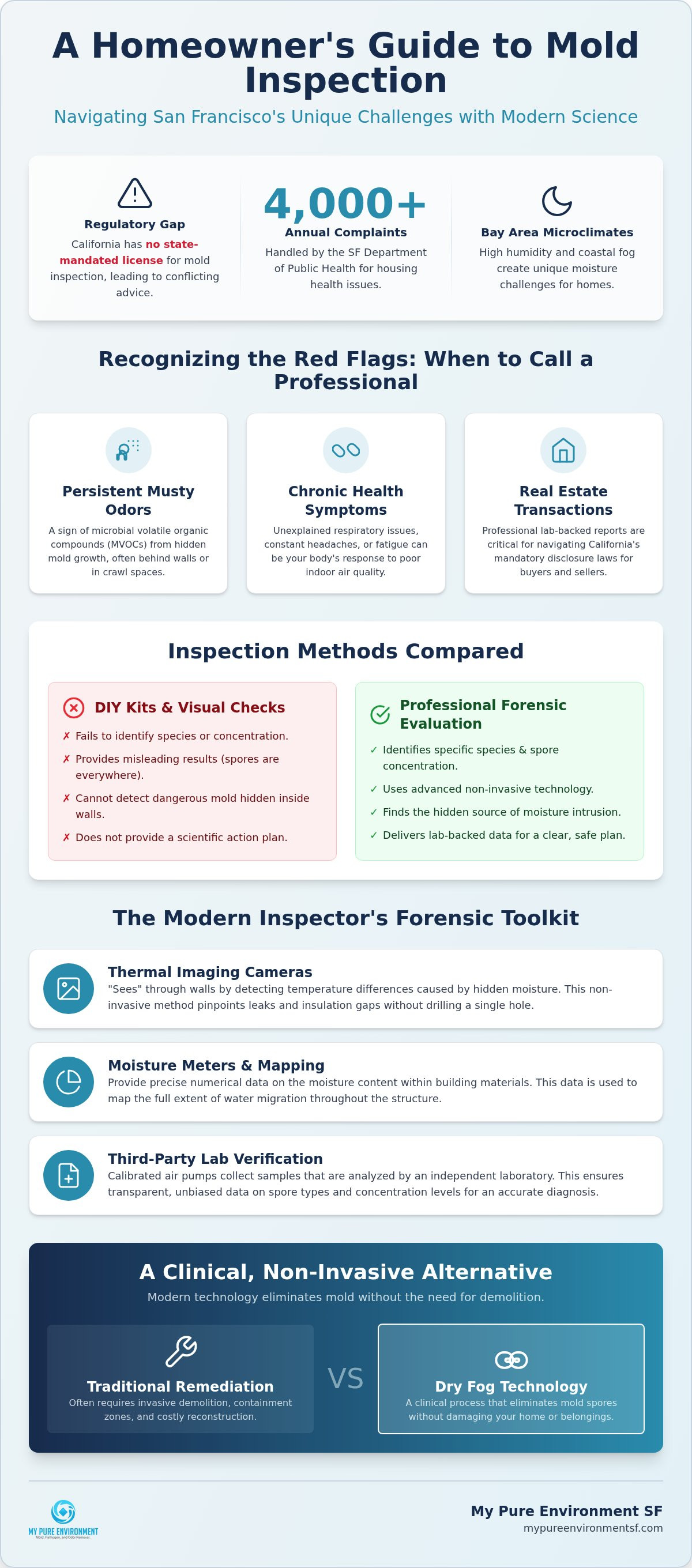
Identifying mold isn't always as simple as spotting a dark patch on a bathroom ceiling. In the unique microclimates of San Francisco, moisture often hides in structural cavities where it remains invisible to the naked eye. Relying on DIY mold kits often provides misleading results because these petri dishes simply confirm that mold spores exist in the air, a fact true of almost every environment. They fail to identify the concentration or the specific species present. For a definitive answer, homeowners should engage mold inspection professionals who can differentiate between normal background levels and a systemic growth issue.
During San Francisco real estate transactions, professional verification is a critical safeguard. California law requires sellers to disclose known hazardous conditions, and landlords must provide specific dampness and mold information to tenants. A professional report provides the lab-backed data needed to navigate these legal requirements with transparency and peace of mind. It ensures that both parties understand the true state of the property's air quality before any contracts are finalized.
The Limitations of Visual "Self-Inspections"
Visual inspections are a logical first step, but they rarely tell the whole story. Mold thriving behind drywall or under floorboards can be more hazardous than surface growth because it often goes undisturbed, allowing high concentrations of spores to build up in stagnant air. If you notice a persistent musty odor that doesn't dissipate with increased ventilation, you're likely smelling microbial volatile organic compounds (MVOCs). In the Bay Area, high humidity and coastal fog frequently drive moisture into attics and crawl spaces. These areas require specialized assessment to ensure the building's envelope hasn't been compromised by the city's damp air.
Health-Triggered Inspections: When Your Body is the Sensor
Sometimes, the most reliable indicator of a problem isn't a smell or a stain, but your own physical response. Chronic respiratory issues, persistent headaches, or unexplained fatigue can all stem from poor indoor air quality. For individuals sensitive to environmental toxins, such as those dealing with Chronic Inflammatory Response Syndrome (CIRS), a standard visual check is insufficient. They require Advanced Methods Used by Modern Inspectors to verify that the living space is clinically clean. Addressing bathroom mold removal promptly is essential; it's a health-first priority rather than an aesthetic fix. Because bathrooms are high-moisture zones, they often serve as the primary indicator for larger systemic issues that mold inspection professionals are trained to detect.
The Forensic Toolkit: Advanced Methods Used by Modern Inspectors
Modern mold inspection professionals don't rely on guesswork. They use a suite of forensic tools designed to see through structural barriers and quantify invisible threats. This clinical approach ensures that we identify the root cause of moisture without tearing apart your home's infrastructure. By focusing on non-invasive detection, we provide a clear roadmap for restoration that prioritizes both your health and the integrity of your property.
Infrared and Moisture Forensics
Thermal imaging cameras are a cornerstone of modern inspections. These devices detect minute temperature differentials on surfaces, which often indicate hidden moisture or insulation gaps behind drywall. Because water evaporates, it cools the surrounding material. The infrared sensor captures this thermal signature, allowing us to "see" a leak without drilling a single hole. It's a meticulous way to identify systemic issues that a visual check would miss.
Once a thermal anomaly is found, we use moisture meters to distinguish between high ambient humidity and active water intrusion. These specialized sensors provide a numerical value for the moisture content within wood, plaster, or concrete. We then utilize this data for moisture mapping, which is a systematic way to track water migration throughout the building's envelope. This forensic process is essential for understanding When to Hire Mold Inspection Professionals versus when a simple surface cleanup might suffice.
Air Quality and Spore Analysis
Quantifying the invisible threat requires laboratory-grade air sampling. During this process, we use calibrated pumps to pull a specific volume of air through a collection cassette. These samples are then analyzed by a third-party microbiologist to identify the concentration and species of mold spores present. It's about scientific accuracy, not just a "pass or fail" result.
Interpreting these results effectively requires a baseline comparison. We always compare indoor spore counts to San Francisco outdoor baselines to determine if the indoor environment has an active fungal source. For a deeper dive into how we evaluate these metrics, you can refer to our San Francisco mold testing guide for property owners. If specific colonies are visible, surface lift or bulk sampling provides definitive species identification. This ensures we know exactly what we're treating, whether it's a common allergenic mold or something more concerning. Understanding the "why" behind the growth is the first step toward a permanent solution. If you're concerned about your indoor air, a professional assessment can provide the lab-backed peace of mind you need.
Navigating the Conflict of Interest in Mold Testing and Remediation
A common debate exists among mold inspection professionals regarding whether a single firm should handle both detection and remediation. Some industry voices claim this creates an inherent conflict of interest, suggesting that an inspector might find problems just to sell a cleanup service. However, this perspective often ignores the logistical benefits of a cohesive, health-focused plan. When a firm specializes strictly in environmental health rather than general construction, their primary goal is restoring air purity, not selling a massive rebuilding project. The key to trust isn't necessarily the separation of firms, but the presence of objective, verifiable data.
The Importance of Third-Party Lab Verification
Transparency is maintained through independent verification. Reputable mold inspection professionals always send their air and surface samples to an accredited, third-party laboratory. This ensures that the data driving your remediation plan is objective and unbiased. The inspector collects the evidence, but a separate microbiologist interprets the results. Once the work is finished, post-remediation clearance testing provides the clinical proof that the environment is safe. This scientific verification ensures your report meets the rigorous black mold testing San Francisco standards, giving you lab-backed peace of mind that the issue was fully resolved.
Accountability in the Remediation Journey
Choosing an integrated firm creates a single point of accountability for your home's air quality. When one specialist manages the process from forensic detection to final clearance, there's no "fragmented responsibility" between different contractors. You won't find yourself caught in the middle of a dispute where an inspector identifies a problem and a separate remediator claims the inspector's plan is flawed. This streamlined approach allows for a faster transition from discovery to a clean living space.
Be wary of contractors who use "scare and tear" tactics to pressure you into immediate action. If a company suggests ripping out walls before they've even received lab results, it's a major red flag. Specialized firms avoid the high-pressure sales tactics often associated with general construction and rebuilding. Instead, they focus on systemic health and non-invasive methods that protect your home's structure. By relying on data rather than fear, these professionals act as protective guides, ensuring you have a clear, non-invasive path to a healthy environment.
Hiring Criteria for San Francisco Mold Experts: What to Verify
Since California does not issue a state-specific license for mold inspectors, the burden of verification falls on the homeowner. You must look for mold inspection professionals who hold credentials from nationally recognized organizations. These certifications represent a commitment to standardized science and ethical conduct in an industry that can sometimes feel unregulated. By choosing a certified expert, you ensure that your home's assessment is based on established environmental health protocols rather than guesswork.
Certifications and Industry Standards
Look for acronyms like IICRC (Institute of Inspection, Cleaning and Restoration Certification) or ACAC (American Council for Accredited Certification). These organizations require rigorous testing and ongoing education to maintain membership. However, a certification is only a starting point. Ask mold inspection professionals about their specific experience with toxic mold in high-density urban environments. A professional who usually works on new suburban builds might not understand the complexities of a 100-year-old lath-and-plaster wall in Pacific Heights. Experience in the field is what transforms a certificate into true expertise.
The San Francisco Factor: Climate and Architecture
San Francisco’s unique microclimates, particularly the persistent coastal fog in the Sunset and Richmond districts, create environmental pressures rarely seen elsewhere. This moisture often settles in unconditioned attics or crawl spaces, leading to slow-growing, hidden colonies. Historic Victorian and Edwardian homes present additional challenges due to their intricate framing and lack of modern vapor barriers. Choosing a specialist who understands these architectural nuances is vital. It ensures that the assessment follows a professional mold remediation in San Francisco framework that respects local building codes and historic preservation needs.
Insurance and the "No Demolition" Philosophy
Always verify that the firm carries professional liability and pollution insurance. This protects your property if an inspection accidentally disturbs a hidden colony. Beyond insurance, ask about their investigative philosophy. True experts prioritize a "No Demolition" approach. Instead of suggesting you rip out walls just to find a leak, they should use the forensic tools discussed earlier to pinpoint the issue. This philosophy values your home's structural integrity and aims for the least invasive path to air purity. If you're ready to secure a clinical assessment of your home, you can schedule a professional inspection with our local team today.
Beyond the Report: How My Pure Environment SF Bridges the Gap
Many mold inspection professionals provide a detailed analysis of the problem but leave the homeowner to manage the chaotic aftermath of traditional remediation alone. My Pure Environment SF changes this dynamic by offering a seamless transition from forensic detection to a science-based restoration. We don't just identify the presence of spores; we provide a clinical, non-invasive path to total air purity. This ensures your home returns to a safe state without the stress, debris, and high costs associated with general construction and rebuilding.
Our commitment to systemic health means we look past the immediate symptoms of a mold colony. We focus on the underlying environmental factors that allow moisture to thrive in the first place. By acting as a protective guide throughout the entire process, we ensure that the lab-backed data from your inspection translates into a practical, effective plan for a healthy living space.
Non-Invasive Remediation Technology
Traditional methods often rely on "scare and tear" tactics that involve ripping out drywall and creating massive amounts of dust and secondary contamination. Our specialized dry fog technology utilizes a micron-sized mist that saturates the entire volume of a room, reaching spores hidden in cracks and crevices that manual cleaning simply misses. This approach is significantly safer for families, pets, and sensitive property because it leaves no toxic residue behind. Dry fog technology eliminates the need for general construction by neutralizing mold at the molecular level without disturbing the structural integrity of your home.
Specialized Niche Expertise
Our local expertise extends beyond residential living spaces into highly regulated environments with specific environmental needs. We address the unique mold challenges in San Francisco’s cannabis sector, where strict compliance and environmental purity are essential for both health and operational success. Whether it's a commercial facility or a recurring issue in a residential attic, our solutions are tailored to the specific moisture pressures of the Bay Area.
We provide targeted solutions for recurring bathroom and attic mold, ensuring that the moisture source is addressed alongside the fungal growth. Maintaining a healthy home requires more than just a one-time check; it demands a partnership with experts who value transparency and scientific accuracy. You can take the first step toward lasting peace of mind and schedule your comprehensive SF mold inspection today to ensure your indoor air is truly safe.
Securing a Healthier Future for Your San Francisco Home
Protecting your property from environmental hazards requires a move beyond surface-level observations toward a clinical, data-driven approach. Scientific accuracy is essential. By understanding the forensic tools available and the value of independent lab verification, you can navigate the complexities of indoor air quality with total confidence. Hiring mold inspection professionals who specialize in the unique architectural and climatic challenges of the Bay Area ensures your remediation plan is both accurate and non-invasive.
Our team of IICRC certified professionals focuses on systemic health, providing the meticulous care your space deserves. We prioritize restoration over demolition, using advanced technology to return your environment to its purest state. You can trust our San Francisco local specialists to handle everything from historic Victorians to modern facilities with clinical precision.
Schedule Your Professional Mold Inspection with My Pure Environment SF and secure the peace of mind that comes with independent lab verification. You don't have to face these concerns alone; a clear, science-based path to a healthier home is just a click away.
Frequently Asked Questions
Do I really need a professional mold inspection if I can see the mold?
Visible mold only confirms a surface issue; it doesn't reveal the systemic moisture source or the extent of invisible spore concentrations. Engaging mold inspection professionals allows for a forensic assessment of the entire property's air quality. This process identifies whether spores have migrated to other rooms and pinpoints the exact water intrusion point. A professional report provides the clinical data needed to ensure the root cause is addressed, preventing the problem from recurring.
How much does a professional mold inspection typically cost in San Francisco?
Costs for a forensic assessment in the Bay Area vary based on the size of your property and the number of lab samples required for a definitive answer. While basic visual checks are less intensive, a comprehensive evaluation involving thermal imaging and air quality sampling involves more specialized equipment. You should prioritize firms that provide a clear, itemized breakdown of lab fees and inspection time, ensuring you receive transparent data without hidden administrative charges.
Will a mold inspector have to tear open my walls to find the problem?
Modern inspectors utilize non-invasive technology to evaluate your home's structural health without causing damage. By using infrared cameras and moisture mapping, specialists can see through drywall to detect active leaks or condensation issues. This "no demolition" approach preserves your home's integrity while providing a clear plan for restoration. You don't have to worry about invasive wall cuts unless the lab data and forensic tools confirm a significant hidden colony that requires physical removal.
How long does it take to get mold test results back from the lab?
Most homeowners receive their comprehensive lab reports within two to three business days after the initial site visit. This timeline accounts for the secure chain of custody required to transport samples to an accredited, third-party laboratory. Once the microbiologist analyzes the spore concentrations, your inspector interprets the findings into a structured, actionable plan. This methodical pace ensures that every data point is verified before you begin the remediation process, prioritizing scientific accuracy over speed.
What is the difference between a mold inspection and a general home inspection?
A general home inspection is a broad overview of a building's systems, while a mold inspection is a specialized forensic investigation into indoor air quality. General inspectors often lack the calibrated air pumps and infrared technology needed to detect microscopic environmental hazards. By hiring dedicated mold inspection professionals, you gain access to a deeper level of expertise focused strictly on microbial growth and moisture forensics, ensuring that subtle health risks aren't overlooked during a standard property check.
Can a mold inspection help with my landlord-tenant dispute in SF?
A professional report is a vital tool in San Francisco, where mold is classified as a public health nuisance under the local health code. Landlords are legally required to provide a habitable environment, and lab-backed data proves whether a property meets these safety standards. Having a clinical assessment from a certified expert provides the objective evidence needed for a transparent resolution. It empowers both parties to move forward with a clear, science-based plan for restoration.
What certifications should I look for in a mold inspection professional?
You should prioritize experts who hold credentials from the IICRC, ACAC, or NORMI. These organizations require rigorous training in environmental science and building health, ensuring the inspector follows industry-standard protocols like the S520. Beyond these certifications, look for specialists with local experience in San Francisco's unique microclimates. This combination of national accreditation and local knowledge ensures your inspection is handled with the clinical precision required to protect your home's long-term air purity.
Is air testing for mold spores actually accurate?
Air testing is a highly reliable method for quantifying the invisible microbial load within your living space. By comparing indoor samples against an outdoor baseline, inspectors can determine if there is an active fungal source hidden behind walls or in HVAC systems. This process captures spores that surface testing misses, providing a systemic view of your home's health. When performed by certified specialists using calibrated equipment, air sampling offers the scientific proof needed for total peace of mind.
