
Sanitizing Grow Rooms for Mold: 2026 Cultivator's Guide
Did you know that California recently saw an 800% spike in state-issued product recalls, primarily driven by pathogenic Aspergillus contamination? For cultivators in San Francisco, this statistic isn't just a data point; it represents the thin line between a profitable harvest and a total loss. You understand that even a single microscopic spore can jeopardize months of hard work. When you're sanitizing grow rooms for mold, the traditional approach of manual scrubbing often falls short of the rigorous standards required by the July 2026 DCC regulations.
It's frustrating to battle recurring powdery mildew or botrytis despite your best efforts at cleanliness. This guide will help you master the science of grow room sanitation to eliminate mold spores, protect your crop yields, and ensure your facility meets the latest 2026 cannabis compliance standards. We will explore the limitations of traditional fungicides, the technical advantages of sub-micron dry fogging for systemic health, and the specific protocols required to maintain a sterile environment within the unique coastal microclimate of San Francisco.
Key Takeaways
- Identify the components of the "Mold Triangle" and why standard cleaning methods often fail to eliminate microscopic spores in high-humidity environments.
- Discover how sanitizing grow rooms for mold with dry fog technology provides a systemic reset that manual scrubbing simply cannot achieve.
- Learn the step-by-step "green-out" protocol to effectively remove organic debris and green waste between cultivation cycles.
- Gain insights into the 2026 California DCC sanitation standards to ensure your facility remains compliant and your product passes state-mandated testing.
- Understand the critical differences between surface cleaning and professional air quality restoration to protect your canopy from pathogenic Aspergillus.
The Grow Room Mold Ecosystem: Why Traditional Cleaning Fails
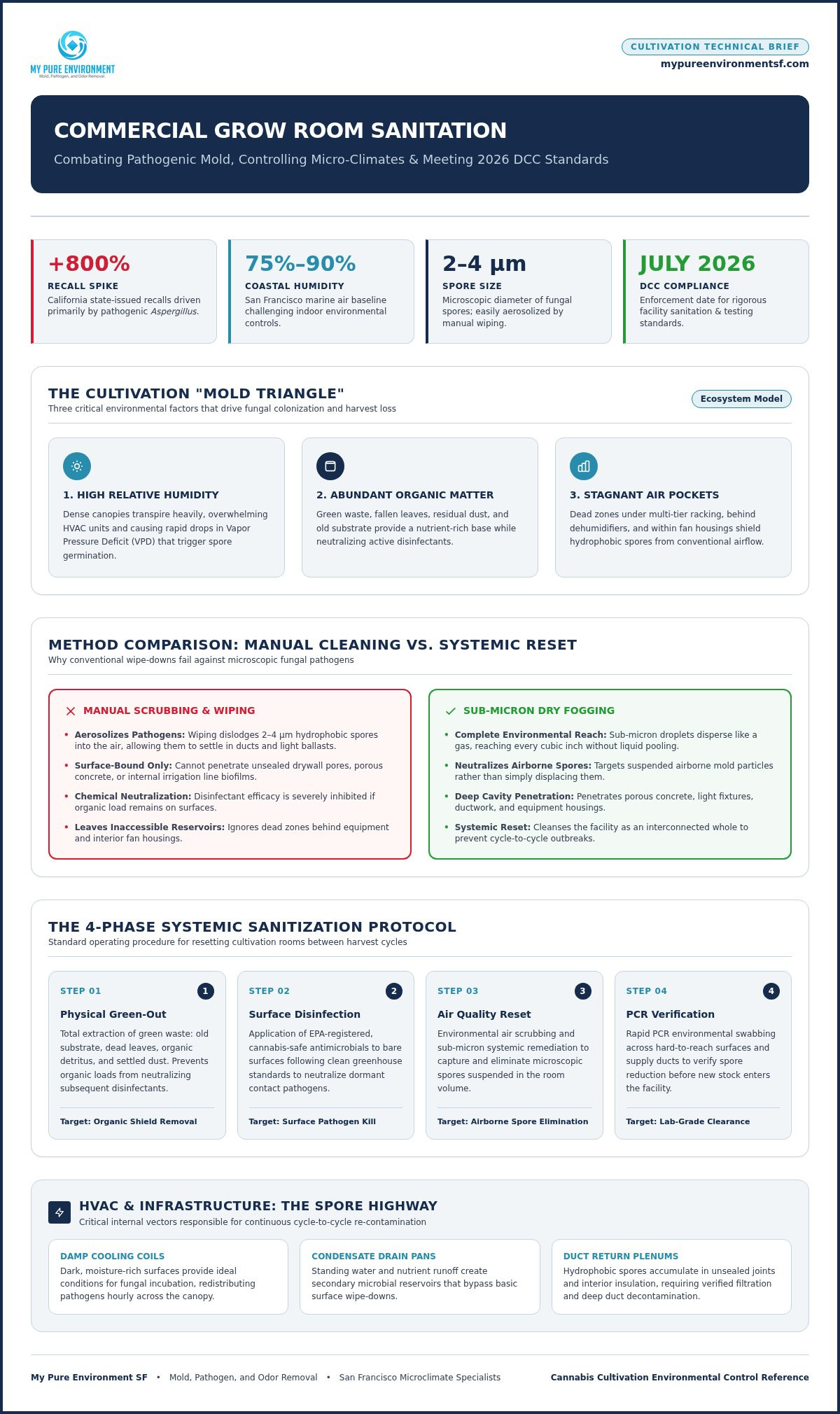
The success of a commercial harvest depends on controlling an invisible environment. Cultivators often focus on visible cleanliness, but sanitizing grow rooms for mold requires understanding the "Mold Triangle." This ecosystem consists of high relative humidity, abundant organic matter, and pockets of stagnant air. In San Francisco, where coastal marine air keeps outdoor humidity between 75% and 90%, indoor facilities face constant pressure. Even when surfaces appear spotless, microscopic spores remain dormant in porous concrete or within the complex biofilms of irrigation lines.
Standard household cleaners and manual scrubbing don't always work because they address symptoms rather than the source. Fungal spores are resilient and often hydrophobic, meaning water-based sprays might simply displace them. When you wipe a surface with a cloth, you risk aerosolizing these 2-to-4-micron particles, allowing them to settle in hard-to-reach areas like light ballasts or return air ducts. A room that looks pristine to the naked eye can still harbor enough pathogens to cause a catastrophic failure during state-mandated lab testing.
The Biology of Grow Room Pathogens
Understanding the life cycle of common threats like Powdery Mildew and gray mold is essential for effective remediation. Research into Botrytis cinerea pathogen biology shows that these fungi thrive in the moist, nutrient-rich environments found in modern cultivation rooms. As plants transpire, they create a layer of high humidity around the foliage. In high-density 2026 grows, this transpiration can overwhelm HVAC systems, creating micro-climates where spores germinate rapidly. Systemic contamination occurs when fungal spores permeate the entire facility infrastructure, including HVAC systems and structural surfaces, rather than remaining localized on a single plant or bench.
Micro-climates and Stagnant Air Pockets
Airflow is your primary defense, yet most facilities contain "dead zones" where air movement doesn't reach. These pockets often exist behind dehumidifiers, under multi-tier racking, or inside dense canopies. When the Vapor Pressure Deficit (VPD) drops too low, it signals fungal spores to begin the germination process. Traditional scrubbing ignores these dangerous reservoirs because manual labor can't reach inside fan housings or deep into unsealed drywall pores. Effective sanitizing grow rooms for mold must account for these hidden areas to prevent recurring outbreaks in the next cycle.
The Anatomy of a Systemic Sanitization Protocol
A systemic protocol is the foundation of any successful harvest reset. It moves beyond superficial wiping to address the facility as a single, interconnected organism. This process requires a rigid four-phase approach to ensure that no dormant pathogens survive to infect the next cycle. By treating the environment as a whole, you eliminate the "pockets" where spores typically hide.
Phase 1 involves the total physical removal of organic debris, often referred to as "green waste." This includes old substrate, fallen leaves, and dust that can shield spores from disinfectants. Once the room is physically clear, Phase 2 focuses on surface disinfection using EPA-registered, cannabis-safe antimicrobials. Following established greenhouse cleaning and disinfection protocols is vital here; applying a disinfectant to a dirty surface is largely ineffective because the organic load can neutralize the active chemistry.
Phase 3 shifts the focus to environmental air scrubbing. Since spores are microscopic and airborne, sanitizing grow rooms for mold must include a plan for the air itself. Finally, Phase 4 concludes with post-sanitization testing. Utilizing rapid PCR environmental swabbing allows you to verify spore count reduction before the first plant enters the room. If you are unsure about your facility's current baseline, a professional mold and cannabis service can provide the detailed testing needed for peace of mind.
HVAC and Ductwork: The Spore Highway
Your air conditioning system is often the primary vector for re-contamination. Spores settle on damp cooling coils and inside condensate pans, where they thrive in the dark, moist environment. As the fans cycle, these pathogens are distributed throughout the facility every hour. Securing the air supply is a critical step in sanitizing grow rooms for mold. This requires a deep clean of all internal duct surfaces and the verification of filtration efficiency to ensure that the air circulating over your canopy is truly sterile.
Irrigation and Hydroponic System Sterilization
Water-borne pathogens often hide within biofilms, which are slimy layers of bacteria and fungi that coat the inside of nutrient lines. These films protect colonies from standard flushes. To protect the root zone, you must use specialized line cleaners or stabilized hydrogen peroxide to break down these matrices. This ensures that your irrigation system delivers nutrients, not pathogens, to your 2026 crop. Protecting the root zone from these fungal threats is just as important as maintaining surface cleanliness.
Comparing Sanitization Methods: Manual Scrubbing vs. Dry Fog Technology
Manual scrubbing has been the industry standard for years, yet it's inherently limited by human physical capacity. In a large-scale facility, even the most diligent crew will miss spots in light ballasts, rack seams, or high-clearance corners. Sanitizing grow rooms for mold using only cloths and spray bottles often leads to localized pockets where pathogens survive. These microscopic survivors then bloom during the high-humidity late stages of the next harvest, leading to unexpected crop failure.
Traditional chemicals like bleach or heavy fungicides present another significant hurdle. In 2026, the California Department of Cannabis Control testing standards are more stringent than ever. Residual chemicals on surfaces or infrastructure can lead to failed lab tests or degraded plant health. Beyond compliance, corrosive chemicals can damage expensive LED arrays and environmental sensors over time. Dry Fog technology offers a systemic alternative by atomizing cold sterilants into droplets measuring between 1 and 10 microns. These sub-micron particles behave like a gas, filling the entire room volume and penetrating every crack and air duct without leaving a wet residue.
Why Dry Fog is the 2026 Gold Standard
The primary advantage of dry fog mold remediation is its ability to provide total room sterilization without damaging sensitive electronics. Because the droplets are so small, they bounce off surfaces rather than wetting them, maintaining humidity levels below saturation. This process reaches the "unreachable" areas, such as the interior of HVAC units and the spaces behind unsealed drywall. By reducing the manual labor hours required and ensuring a total kill, this method offers a significant efficiency advantage for zero-downtime harvest resets.
Manual Cleaning: When is it Enough?
Manual cleaning still plays a vital role as a preliminary step. It's essential for the physical removal of organic debris and green waste that can shield pathogens from the fog. However, your crew must use proper PPE, including full-face respirators, to prevent cross-contamination or health risks. Relying solely on manual labor often fails to meet cannabis compliance mold testing standards because it cannot treat the air column where spores remain suspended. Professional fogging should be viewed as the final, essential layer of protection for every harvest reset.
Step-by-Step Guide: Resetting Your Facility Between Harvests
A successful harvest reset requires a disciplined, methodical approach to ensure no pathogens survive from one cycle to the next. Sanitizing grow rooms for mold is a multi-phase operation that begins with a complete "Green-Out." This involves removing every piece of plant material, including root balls, spent substrate, and even the smallest leaf fragments. Once the room is physically empty, you can proceed to the deep clean of all hardware. This includes lights, fans, and pots that often harbor hidden colonies.
The systemic environmental treatment, known as the "Kill Phase," follows the physical removal of debris. This is when professional technology ensures that the air column and structural surfaces are truly sterile. After treatment, your focus shifts to environmental stabilization. You must dial in your Vapor Pressure Deficit (VPD) before the next flip to prevent the high-humidity spikes that trigger dormant spores. Finally, verification testing confirms you have a clean slate. Skipping this final check is a gamble with your 2026 compliance and future yields.
Cleaning Your Hardware: Lights, Fans, and Trays
Hardware components are often the most overlooked reservoirs for pathogens. LED heat sinks are notorious for trapping dust, which acts as the primary carrier for spores in a dry grow room. Use compressed air followed by an antimicrobial wipe-down for these sensitive components. Oscillating fan blades also accumulate a layer of biofilm over time. These should be removed and soaked in a professional disinfection solution for at least 10 minutes to ensure total pathogen elimination. Reusable trays and pots require similar soaking protocols to protect the root zone of your next crop.
The Reset Checklist: Don't Miss These Spots
When sanitizing grow rooms for mold, don't overlook the "touch points." Ceiling grids, door handles, and light switches are often neglected but can harbor significant microbial loads that lead to cross-contamination. It's equally vital to sanitize your Mother Room and clone areas. Bringing a single infected clone into a sterile flower room will undo all your previous efforts. You can find a comprehensive audit of these critical zones in our cannabis facility checklist.
If you're ready to secure your next harvest with a professional-grade reset, contact us today for specialized mold and cannabis services.
Cannabis Compliance and Professional Remediation in San Francisco
San Francisco cultivators operate in one of the most demanding regulatory and environmental climates in the world. As of July 1, 2026, the California Department of Cannabis Control (DCC) transitioned from voluntary guidance to mandatory minimum sanitation standards under rulemaking package DCC-2025-01-R. These regulations enforce a zero-tolerance policy for pathogenic Aspergillus species, including A. flavus, A. fumigatus, A. niger, and A. terreus. If a batch fails, the consequences are severe. While remediation is possible through an approved Corrective Action Plan (CAP), the resulting product carries a permanent "R" flag in the METRC system. This designation typically results in a wholesale price penalty of 30% to 50% compared to unflagged, pristine flower.
The local environment adds another layer of complexity. Because San Francisco County prohibits outdoor commercial cultivation, all operations must occur within permanent indoor structures. The city's coastal marine air frequently maintains relative humidity between 75% and 90%, placing an immense load on HVAC systems during the harvest reset. Sanitizing grow rooms for mold in this microclimate requires more than just standard cleaning; it demands a systemic approach that accounts for moisture-laden air entering the facility through intake vents and unsealed gaps.
Meeting SF Local Air Quality Standards
Professional air testing is a critical component of 2026 compliance. It provides a documented trail of cleanliness that protects your business from liability and ensures your canopy remains healthy. Integrating professional mold remediation for cannabis facilities into your Standard Operating Procedures (SOPs) ensures that your environment meets both state and local air quality benchmarks. Third-party lab verification offers the scientific proof needed to move from one cycle to the next with confidence, reducing the stress of potential state-mandated recalls.
When to Call the Professionals
You should consider professional intervention when microbial failures become a recurring theme despite your manual efforts. Signs of systemic contamination include persistent outbreaks in specific "dead zones" or failing tests for Aspergillus even when surfaces look clean. Preparing for a professional Dry Fog treatment is a straightforward process that minimizes downtime. By evacuating the room and isolating the HVAC system, you allow the sub-micron particles to reach every hidden reservoir. My Pure Environment SF acts as your partner in maintaining a sterile workspace, ensuring that sanitizing grow rooms for mold is a proactive strategy rather than a reactive crisis. This protective guidance helps you maintain a "Pure Environment" for premium, high-value crops that meet the strictest retail standards.
Secure Your Future Harvests with a Sterile Foundation
Achieving a pathogen-free environment requires moving beyond surface-level cleaning to address the entire facility ecosystem. By adopting systemic protocols and advanced dry fogging, you eliminate the microscopic threats that traditional methods miss. This proactive stance is the most effective way to navigate the rigorous 2026 DCC standards while protecting your bottom line from failed tests and wholesale price penalties. Mastering the science of sanitizing grow rooms for mold ensures that every cycle begins with total environmental purity and absolute compliance.
As San Francisco local experts, My Pure Environment SF provides specialized Dry Fog technology for cannabis that offers non-invasive, no-demolition mold removal. Our methodical approach prioritizes your facility's air quality and systemic health without the need for destructive methods. Request a Professional Grow Room Sanitization Quote from My Pure Environment SF to safeguard your facility and maximize your yields. You've invested significant effort into your cultivation space; let's work together to ensure your environment supports the high-value, pristine crops you deserve.
Frequently Asked Questions
What is the best disinfectant for sanitizing a grow room?
EPA-registered peracetic acid and hydrogen peroxide blends are the gold standard for 2026 cultivation. These compounds are highly effective against a broad spectrum of pathogens while breaking down into harmless water and oxygen. Unlike traditional chemicals, they don't leave toxic residues that could compromise your final product or fail state-mandated lab tests. Using these within a systemic protocol ensures your facility remains a pure environment for high-value crops.
Can I use bleach to clean my grow room between harvests?
You should avoid using bleach for sanitizing grow rooms for mold because it's highly corrosive to expensive infrastructure and leaves hazardous residues. Bleach often fails to penetrate porous surfaces like concrete or unsealed drywall, allowing fungal roots to survive and re-emerge. Additionally, the chlorine gas emitted can be harmful to workers and sensitive plants. Modern cultivators prefer non-corrosive, systemic alternatives that ensure a total kill without damaging equipment or affecting plant quality.
How long does it take to professionally sanitize a commercial grow facility?
A professional sanitization of a commercial facility typically takes between six and twelve hours for the active "kill phase," depending on the total square footage. This timeline is significantly faster than manual scrubbing, which can take days and often misses critical areas. Dry fogging allows for a zero-downtime harvest reset, meaning you can move your next cycle into a sterile environment almost immediately after the gas clearance meters confirm safe levels.
Will sanitizing my grow room with fog damage my expensive LED lights?
Dry fog technology won't damage your expensive LED lights because the droplets are sub-micron in size and behave like a gas. These particles measure between 1 and 10 microns, which is small enough to bounce off surfaces without wetting them. This non-invasive method ensures that sensitive electronics, environmental sensors, and light ballasts remain dry and functional while still receiving total sterilization from the airborne antimicrobial agent.
How often should I perform a deep systemic sanitation of my facility?
You should perform a deep systemic sanitation of your facility between every single harvest cycle. This "reset" ensures that any pathogens accumulated during the previous grow are eliminated before they can infect new clones or seedlings. In the high-humidity microclimate of San Francisco, a regular schedule is vital for maintaining 2026 compliance. Consistent sanitation prevents the buildup of systemic contamination that can lead to catastrophic crop loss and failed lab results.
What are the most common signs of mold growth in cannabis crops?
The most common signs of mold growth include white, flour-like spots on leaves indicative of Powdery Mildew or gray, fuzzy patches known as Botrytis. You might also notice a damp, musty odor or localized wilting within a dense canopy. However, the most dangerous sign is a failed Certificate of Analysis (COA) for Aspergillus. Because spores are microscopic, your room can harbor significant pathogen loads even if the plants look healthy to the naked eye.
Is professional mold remediation in San Francisco required for commercial licenses?
While the San Francisco Office of Cannabis doesn't explicitly mandate a specific contractor, cultivators must meet the strict 2026 California DCC sanitation standards to maintain their commercial licenses. These regulations require mandatory minimum biosecurity and facility cleanliness levels. Professional mold and cannabis services in San Francisco provide the necessary lab-verified testing and systemic remediation to ensure your facility avoids the 30% to 50% wholesale price penalties associated with remediated "R" flagged batches.
How do I pass a state-mandated mold test after a previous failure?
Passing a state-mandated test after a previous failure requires a total systemic reset and professional air quality restoration. You must submit an approved Corrective Action Plan (CAP) through METRC and address the root cause, such as stagnant air pockets or HVAC contamination. Sanitizing grow rooms for mold using dry fog technology eliminates the airborne spores that manual cleaning misses. Once the treatment is complete, performing third-party rapid PCR swabbing verifies your facility is clean before the next test.
