
Mold Spore Air Testing: Accuracy, Benefits, and Professional Standards
What if the invisible air in your living room is the primary cause of your persistent fatigue or respiratory issues? While many homeowners search for visible stains on the walls, the most significant environmental threats often remain unseen, floating silently in every breath you take. It's deeply unsettling to suspect your home might be making you sick, particularly when retail DIY kits offer confusing results or lack the precision needed for a real solution. You aren't alone in feeling frustrated by the gap between a generic home test and the clinical certainty you need for true peace of mind.
Professional mold spore air testing bridges this gap by providing a scientific snapshot of your indoor environment. This article explains how expert air testing identifies hidden mold threats and why laboratory-grade data is essential for maintaining a healthy home. We'll explore the rigorous accuracy of professional standards, the specific types of mold that air samples can detect, and how these results provide a clear roadmap for remediation. By moving beyond guesswork, you can confirm if spores have reached dangerous levels and take the first step toward restoring your home's purity and safety.
Key Takeaways
- Understand that professional air testing uses volumetric pumps to measure fungal particulates, providing a clinical baseline that DIY kits can't match.
- Learn why laboratory-grade mold spore air testing is essential for identifying specific species and distinguishing between normal background levels and dangerous infestations.
- Recognize the critical warning signs, like persistent musty odors or unexplained respiratory issues, that indicate a need for a professional air quality assessment.
- Discover how a science-based approach ensures you receive a clear roadmap for remediation without the bias of general construction interests.
What is Mold Spore Air Testing? Defining the Diagnostic Standard
Professional mold spore air testing is a scientific diagnostic tool that provides a volumetric measurement of fungal particulates within an indoor space. Instead of relying on a subjective visual assessment, this method quantifies the exact concentration of spores per cubic meter of air. It creates a data-driven profile of your home's environment, allowing for a clinical analysis of your indoor air quality that prioritizes facts over guesswork.
It's a common misunderstanding that a healthy home should have no mold at all. Mold spores are ubiquitous; they exist in nearly every environment on Earth. The goal of professional testing isn't to find a "zero" count, but rather to determine if indoor levels are "elevated" compared to the natural outdoor environment. A professional assessment looks for an imbalance that suggests an active, hidden growth source is compromising your living space.
Laboratory results typically include both viable (living) and non-viable (dead or dormant) spores. This distinction is vital because even dead spores can contain allergens or toxins that impact health. Air sampling for mold captures the full spectrum of these particulates, revealing systemic issues that a flashlight and a visual walkthrough would inevitably miss. This is especially critical when mold is hidden deep within the building's envelope.
The Role of Airborne Spores in Your Environment
Mold spores travel effortlessly through air currents and HVAC systems. In San Francisco, the local climate ensures there's always a natural background level of mold in the outdoor air. Problems start when these spores enter the home and encounter moisture. Because air moves constantly through a building, a hidden colony in an attic or crawlspace can distribute spores throughout every room. This turns a localized leak into a widespread health concern that affects the entire family's well-being.
The Primary Objective of Air Sampling
The main reason to conduct an air test is to find what you can't see. Mold often colonizes behind drywall, under flooring, or inside wall cavities where visual inspections fail. Sampling provides the quantitative data required to:
- Detect hidden moisture and growth sources that are otherwise invisible.
- Identify specific species, including those capable of producing mycotoxins.
- Create a precise roadmap for professional remediation based on scientific evidence.
This objective data removes the stress of the unknown. It ensures that any necessary cleaning or restoration is based on confirmed findings rather than assumptions, protecting both your property and your health.
The Science of Professional Air Sampling: How It Works
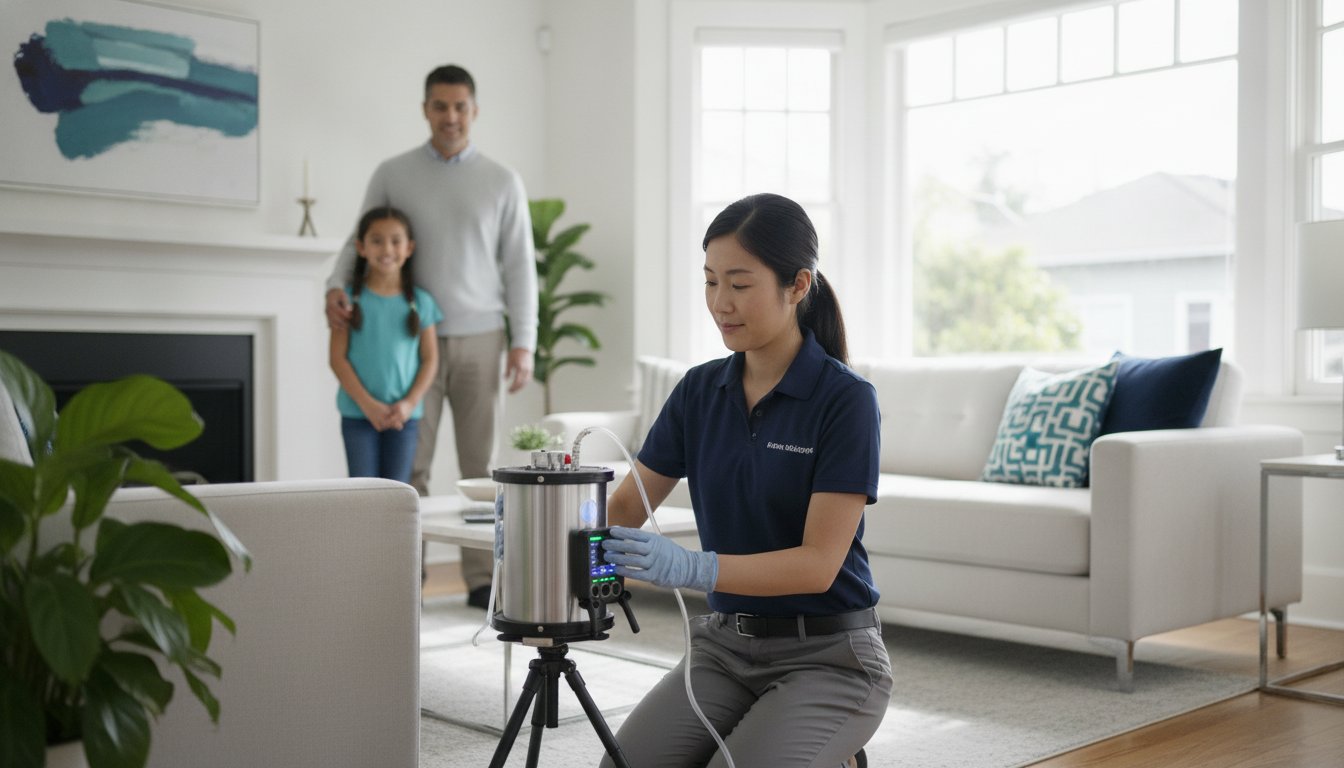
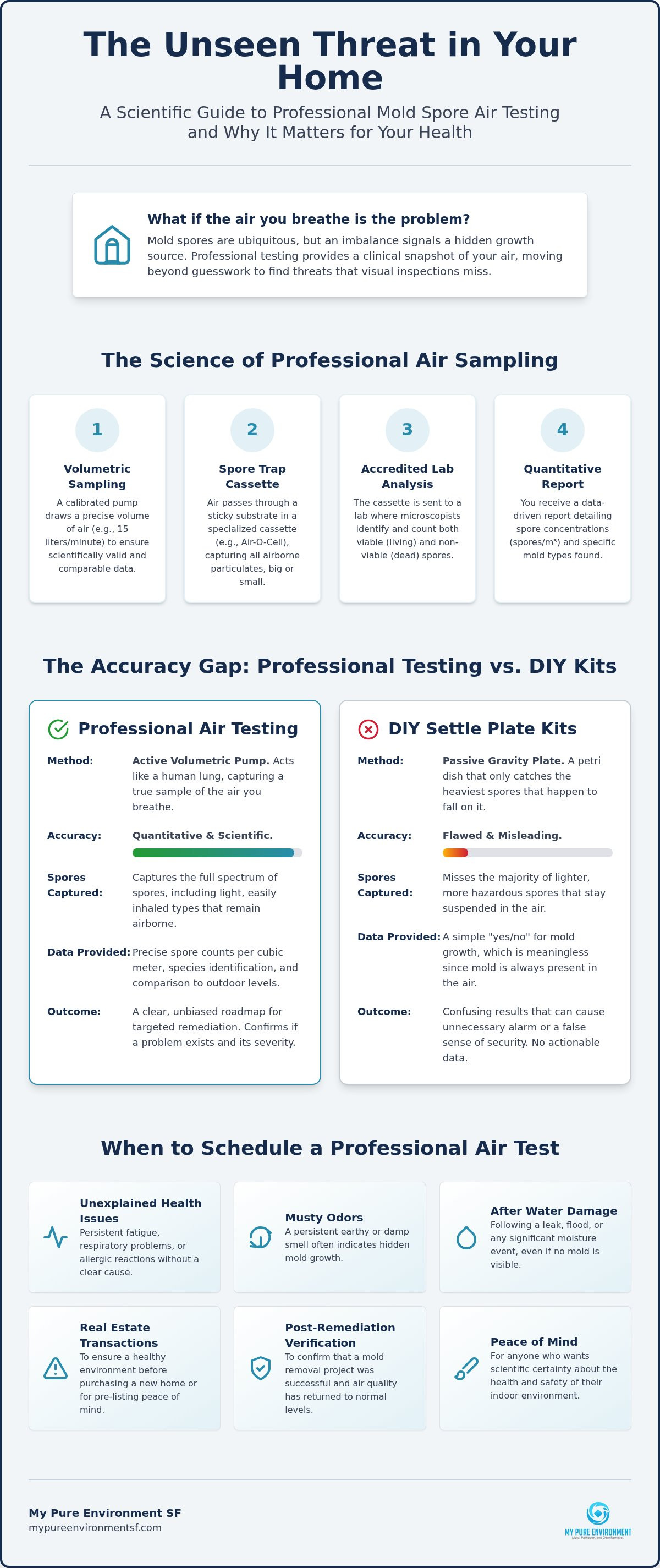
Professional mold spore air testing relies on precision equipment rather than passive observation. The process uses a high-volume air pump connected to a specialized spore trap cassette, such as an Air-O-Cell. These cassettes contain a sticky substrate that captures microscopic particles as air is pulled through the device. This active collection method is the gold standard for accuracy. For the data to be scientifically valid, the pump must be calibrated to a specific flow rate, typically 15 liters per minute (LPM). This standardized flow ensures that the laboratory can calculate the exact number of spores per cubic meter of air, providing a consistent metric for clinical comparison.
During the assessment, a specialist places the equipment at "breathing height," usually three to five feet off the ground. This isn't an arbitrary choice. Since the goal is to evaluate the air that occupants actually inhale, sampling near the floor or ceiling would provide skewed results that don't reflect human health risks. While EPA guidelines on mold testing suggest that sampling isn't always necessary if mold is visible, professional air sampling becomes the primary diagnostic tool when you suspect a hidden problem or need to verify the safety of your indoor environment.
Volumetric Sampling vs. Gravity Plates
Many homeowners turn to "settle plates" or petri dishes found in hardware stores, but these are scientifically flawed for air quality assessment. These plates rely on gravity, meaning they only catch the largest, heaviest spores that happen to fall onto them. Many hazardous mold spores are so light they remain suspended in the air indefinitely, never landing on a plate. A professional volumetric pump acts like a human lung, actively pulling in the air and capturing the full range of spore sizes. This provides a realistic snapshot of what you are actually breathing.
The Critical Importance of Baseline Comparisons
An indoor sample is meaningless without an outdoor control sample taken at the same time. This outdoor baseline accounts for the natural fungal population in your specific area. In San Francisco’s coastal climate, outdoor spore levels can fluctuate significantly based on humidity and sea breezes. A professional analysis compares the indoor species and concentrations against this local baseline. If the indoor air contains species not found outside, or if the counts are significantly higher, it confirms an internal growth source. If you're concerned about your home's air quality, a professional mold inspection can provide the scientific clarity you need.
Professional Testing vs. DIY Kits: The Accuracy Gap
The marketplace is filled with inexpensive DIY kits promising fast and accurate results. However, there is a significant difference between a retail petri dish and professional mold spore air testing. Most "home store" kits provide a binary result: they either grow mold or they don't. Since we've already established that mold spores are present in every environment, these kits almost always produce a positive result. This often creates unnecessary panic for homeowners who see fuzzy growth in a dish without understanding that those spores may be part of the natural, healthy background air of San Francisco.
A professional assessment provides the clinical context that a color-changing strip cannot. Certified inspectors evaluate the building's history, moisture levels, and current air quality to interpret what the data actually means for your health. Beyond the science, professional testing offers a documented chain of custody. This formal record is essential for legal disputes, insurance claims, or real estate transactions where DIY results are typically dismissed as unreliable. When your health or property value is on the line, the precision of laboratory-grade data is the only way to ensure a safe resolution.
Why DIY Petri Dishes Often Fail
Petri dishes, also known as gravity plates, are scientifically flawed for assessing what you breathe. These plates only catch heavy spores that happen to fall out of the air. Many of the most hazardous varieties are microscopic and lightweight, remaining suspended indefinitely. Furthermore, because these dishes contain agar, they act as "food" for mold. They actively encourage growth that might not be a problem in your actual living space. Because they don't measure the volume of air sampled, it's impossible to determine the actual concentration of spores, leaving you with no way to know if your air is dangerous or normal.
The Role of Third-Party Laboratory Analysis
Professional samples are sent to accredited AIHA-LAP laboratories for microscopic analysis. The resulting lab report provides both raw counts and calculated concentrations (spores per cubic meter). Experts then use toxic mold identification guides to translate these numbers into actionable information. While EPA guidelines on mold testing remind us that there are no federal "safe" limits for mold, the value of a professional lies in their ability to compare your indoor environment against outdoor baselines. This comparison reveals whether your home has a systemic issue or simply reflects the natural world outside your door.
When Should You Schedule a Mold Spore Air Test?
Deciding when to invest in mold spore air testing often comes down to recognizing the invisible signals your home is sending. One of the most common triggers is a persistent, earthy, or musty odor that remains even after deep cleaning. If you smell mold but cannot find a visible source, the colony is likely hidden within wall cavities, under floorboards, or inside your ventilation system. In these cases, air sampling acts as a diagnostic scout, confirming the presence of an active growth source that a visual walkthrough would miss entirely.
Health changes among occupants also serve as a critical indicator. If family members experience unexplained respiratory issues, chronic coughing, sneezing, or skin irritation that improves when they leave the house, the indoor air quality is likely compromised. This is especially urgent following a significant water intrusion event, such as a pipe burst, roof leak, or local flooding. Even if the area looks dry, moisture trapped behind drywall can fuel rapid fungal colonization within 24 to 48 hours. For those navigating property changes, our San Francisco mold testing guide provides essential context for buyers and sellers who need documented proof of a building's environmental health.
Post-Remediation Clearance Testing
Once a mold problem has been addressed, air testing is the only way to scientifically prove the remediation was successful. You should never rely on a visual-only clearance. While the visible stains may be gone, microscopic spores can remain suspended in the air or settled on surfaces, ready to recolonize if conditions shift. Professional clearance testing ensures that spore counts have returned to a "normal" baseline level consistent with the outdoor environment. This provides the clinical certainty needed to close out a project and ensure the space is truly safe for re-occupancy.
Testing for High-Risk Occupants
Prioritizing air quality is vital when a home includes infants, the elderly, or immunocompromised individuals. These groups are more susceptible to "Sick Building Syndrome" and the adverse effects of certain fungal species. Toxic mold refers to specific fungal species that are capable of producing secondary metabolites known as mycotoxins under specific environmental conditions. Identifying these species through air sampling allows for a targeted approach to restoration, ensuring the most vulnerable residents are protected from long term exposure. If you suspect your air quality is compromised, you can schedule a professional mold inspection to get the clear answers you deserve.
Professional Air Quality Assessment in San Francisco
At My Pure Environment SF, we understand that living in the Bay Area presents unique environmental challenges. The persistent fog and coastal humidity create microclimates where fungal growth can thrive unnoticed within the modern and historic building styles of San Francisco. Our approach to mold spore air testing is rooted in clinical precision rather than high-pressure sales tactics. We don't just look for visible spots on a wall; we evaluate the systemic health of your entire indoor environment to ensure the air you breathe is pure and safe.
Our team functions as protective guides for property owners, moving beyond the "spot cleaning" mentality often found with general contractors. By utilizing laboratory-grade data, we can recommend non-invasive remediation solutions, such as dry fogging, that address the root cause without the need for destructive demolition. This scientific methodology prioritizes your well-being and provides a clear path to restoration that is both thorough and transparent. We believe that professional testing should reduce stress, not increase it, by providing factual clarity in a crisis.
The My Pure Environment SF Diagnostic Process
Our diagnostic process begins with a comprehensive visual inspection of the property's envelope, paired with calibrated air sampling. We analyze the relationship between indoor and outdoor spore concentrations to identify hidden colonies that may be impacting your health. Once the laboratory returns the results, we provide a transparent report that explains the "why" behind every number. This education-first approach ensures you aren't just looking at a data sheet, but actually understanding the state of your home's ecosystem.
Next Steps After Your Air Test
Interpreting your results is the first step toward a healthier living space. You'll work closely with a mold inspection professional to understand the specific species identified and their potential health implications. If the data confirms elevated counts or hazardous species, the logical progression is to move toward professional mold remediation. Our focus remains on long-term air quality, which includes advising you on moisture control and advanced filtration to prevent future issues. Maintaining a pure environment is a partnership, and we're here to provide the steady hand you need throughout the journey to restoration.
Securing Your Home's Long-Term Environmental Health
The path to a healthy home begins with moving past the uncertainty of DIY kits and embracing the precision of scientific diagnostics. We've explored how professional mold spore air testing provides the clinical data needed to identify hidden threats, distinguish between natural background levels and dangerous infestations, and create a roadmap for non-invasive remediation. By prioritizing laboratory-grade accuracy over guesswork, you ensure that your property and your family's health are protected by facts rather than assumptions.
Our team of specialized San Francisco local experts is dedicated to restoring your peace of mind through a methodical, science-based approach. We provide transparent reporting backed by AIHA-LAP accredited lab results, ensuring you have the authoritative information required for effective action. Don't let hidden mold compromise your living space or well-being. You deserve the clarity that only certified mold inspection professionals can provide.
Schedule Your Professional Mold Air Test in San Francisco Today and take the first step toward a purer, safer indoor environment.
Frequently Asked Questions
Is mold spore air testing really accurate?
Professional air testing is highly accurate when performed with calibrated volumetric pumps and specialized spore trap cassettes. Unlike retail kits, this method measures the exact concentration of spores per cubic meter of air. It provides a scientific snapshot of your indoor environment. For the highest accuracy, we compare indoor results against an outdoor baseline to identify systemic imbalances that indicate a hidden growth source.
How much does a professional mold air test cost in San Francisco?
Costs for a professional assessment vary based on the square footage of the property and the total number of samples collected. National data suggests that a standard mold inspection typically ranges between $303 and $1,045. In the Bay Area, factors such as building complexity and the need for specialized lab analysis will influence the final investment. We provide transparent, detailed breakdowns for every diagnostic project.
Can I perform mold air testing myself with a kit?
Retail DIY kits are generally considered unreliable by insurance companies and environmental professionals. These kits often use "settle plates" that only catch heavy spores and lack any measurement of air volume. This makes it impossible to determine the actual concentration of spores in your home. Professional mold spore air testing uses active suction to capture the full spectrum of inhalable particulates, ensuring scientifically valid results.
What happens if my air test comes back positive for mold?
A positive result provides a clear roadmap for the next steps in restoration. If the laboratory report confirms elevated levels or hazardous species, we recommend a targeted remediation plan. Our focus is on non-invasive solutions, such as dry fogging, which can treat the entire building envelope without the need for destructive demolition. The data allows us to address the root cause while prioritizing your home's systemic health.
How long does it take to get mold air testing results back?
You can typically expect to receive your detailed laboratory report within two to three business days. Once the samples are collected, they are sent to an AIHA-LAP accredited laboratory for microscopic analysis. This specialized processing ensures that every spore is correctly identified and quantified. We then review the findings with you to explain the clinical significance of the data and discuss any necessary remediation steps.
Is black mold always detected in an air test?
Not necessarily. Certain species, such as Stachybotrys chartarum, produce heavy, sticky spores that don't always stay suspended in the air. While mold spore air testing is an essential diagnostic tool, it's most effective when paired with a comprehensive visual inspection and surface sampling. This multi-layered approach ensures that even "heavy" toxic varieties are identified, even if they aren't currently floating in the air at the time of the sample.
Do I need to leave my house during a mold air test?
Occupants don't need to vacate the property during the sampling process. The equipment is quiet and the procedure is entirely non-invasive. However, for the most accurate results, the home should be kept under "closed building conditions" for at least 12 hours prior to the test. This means keeping windows and exterior doors shut to ensure the air sample represents the internal environment rather than outside air currents.
How many air samples are needed for a standard home?
A standard assessment usually requires at least one indoor sample for every 1,000 square feet of living space, plus a mandatory outdoor control sample. We typically recommend taking samples on every floor and near the HVAC system to track how spores might be moving through the building. The specific number of samples is determined by the size of your home and the specific areas where you suspect moisture issues.
