
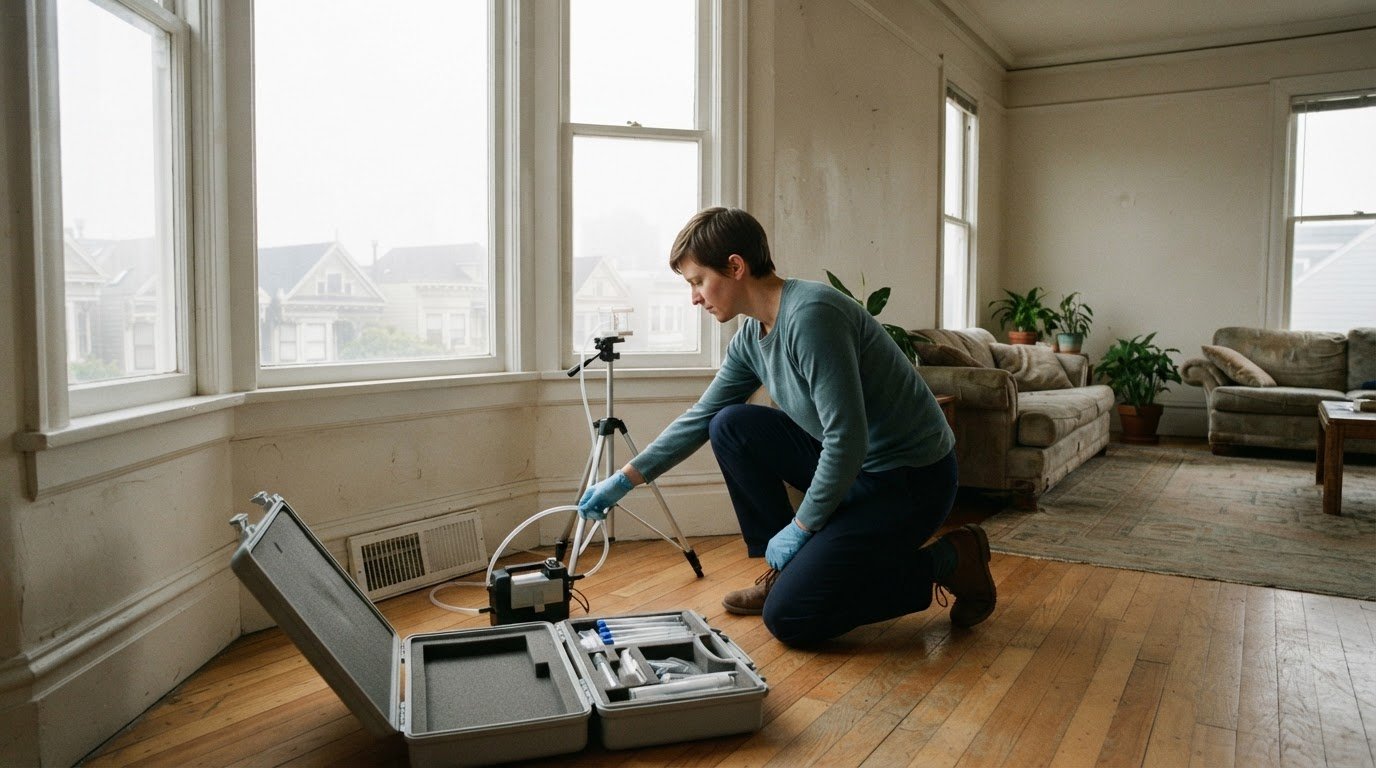
Indoor pollutant levels can be two to five times higher than outdoor levels, according to the U.S. Environmental Protection Agency. For San Francisco homeowners asking how much air quality testing costs in SF, the answer depends on the home, the areas tested, and the pollutants assessed.
It’s reasonable to want a clear estimate before arranging testing. Costs vary between a focused check for one concern and a broader assessment, so defining what you need helps explain the scope.
Test type, property size, symptoms, and sample count can all affect cost. Testing for mold, asbestos, VOCs, and radon addresses different concerns, so start by identifying what you need to know about your home.
Key Takeaways
- Understand how the scope of testing and the pollutants being assessed can shape the overall cost.
- Use symptoms and property concerns to narrow down which type of test may be most relevant.
- See why larger homes may require more samples and a broader assessment.
- Learn how mold, asbestos, VOC, and radon testing address different indoor air concerns.
- Find out when mold testing, inspection, or indoor air quality improvement may be a useful next step.
How Much Does a Home Indoor Air Quality Test Cost?
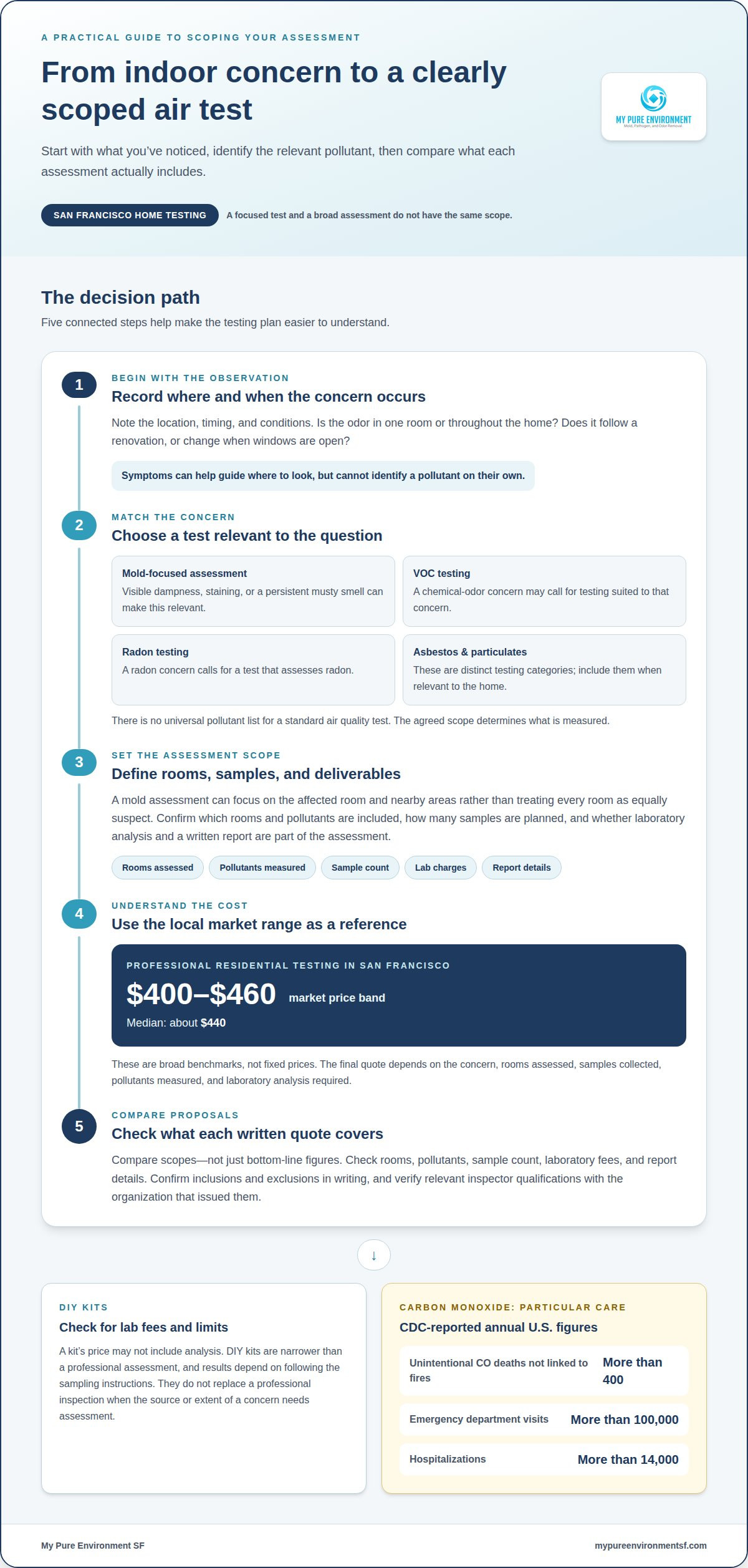
For San Francisco homes, the market price band for professional residential indoor air quality testing is $400 to $460, with a median of about $440. The final scope depends on the concern, rooms assessed, samples collected, and pollutants measured.
Different hazards call for different tests, so a single inspection may not cover every contaminant.
Professional Testing Costs
A professional assessment may involve a visual inspection, targeted sampling, laboratory analysis, and a written report. The market band gives a budgeting reference, but the quote should describe exactly which rooms and contaminants are included.
Ask whether the assessment includes airborne particles, mold-related sampling, or specific chemicals. Additional samples, laboratory analysis, or testing outside the agreed scope can affect the total.
Carbon monoxide calls for particular care. The Centers for Disease Control and Prevention reports that each year, more than 400 Americans die from unintentional CO poisoning not linked to fires, more than 100,000 visit an emergency department, and more than 14,000 are hospitalized.
Budgeting and Cost Reduction
Build your budget around the question the inspection needs to answer, rather than automatically choosing the broadest assessment. A focused test may suit one defined concern; several suspected issues may call for a wider scope.
Share relevant details, such as the rooms affected, visible conditions, odors, and when symptoms or concerns arise. Clear information can help focus sampling and avoid paying for measurements unrelated to the problem. Compare written scopes, not just bottom-line figures.
Before approving an assessment, review the sample count, laboratory charges, report details, and any additional testing. A quote that separates these items shows what affects the cost and whether each measurement addresses your concern.
DIY Testing Costs
A kit’s price may not include analysis, so account for both the materials and any lab submission charge.
These kits are narrower than a professional assessment, and results depend on following the kit’s sampling instructions.
DIY readings may indicate a reason to investigate further, but they don’t replace a professional inspection when you need to assess the source or extent of a concern.
Quote Comparisons and Provider Credentials
Compare quotes by checking which rooms and pollutants are covered, the number of samples, laboratory charges, and report details. Review the inspector’s relevant qualifications and verify them with the issuing organization.
A standard air quality test has no universal pollutant list. Its contents depend on the concern and agreed scope; additional pollutants, samples, or laboratory analysis can add costs. Get inclusions and exclusions in writing before approving the inspection.
These tests address distinct concerns, so include them only when relevant to your home.
Professional indoor air quality testing prices
San Francisco homeowners often ask how much air quality testing costs in SF. The answer depends on the assessment’s scope, including which pollutants are measured, how many samples are collected, and what laboratory analysis is required. The market price band for residential testing provides a local reference, while a quote reflects the specific inspection plan.
Average Testing Cost
These are broad benchmarks, not fixed prices for every San Francisco home. A focused assessment for one concern and a wider evaluation of multiple pollutants require different sampling plans.
Testing can help clarify concerns that a visual inspection alone cannot resolve. Sampling, for example, may help investigate a persistent odor or suspected airborne pollutant. Common categories include mold, VOCs, particulates, radon, and carbon monoxide, each requiring a test suited to that concern.
Consider testing when you need information about a defined indoor condition, such as an odor that persists after renovation or a concern in a particular room. Identifying the question first helps shape an assessment around relevant results, rather than an unnecessarily broad set of measurements.
On-Site Visits and Lab Analysis
How much professional indoor air testing costs in San Francisco depends partly on how the onsite visit and laboratory analysis are itemized. A quote may combine these steps or list them separately. Check whether sample collection, lab fees, and written results are included, and which pollutants each sample assesses.
There is no single charge that applies to every inspection and lab analysis. To compare proposals, match the sampling locations, pollutants, and report details. Check relevant provider qualifications with the organization that issued them, and make sure the proposed scope addresses your specific concern.
Rental, sale, or complaint situations may call for documentation, but testing requirements depend on the circumstances and applicable rules. A clearly scoped inspection can help establish what the assessment measures. For concerns that may involve mold, ways to address indoor air concerns can include testing and inspection tailored to the affected areas.
Choosing a test based on symptoms or property needs
Choose an indoor air test based on a specific concern, not a general impression. A musty odor near a bathroom, for example, points to a different investigation than concern about radon or chemical odors. Symptoms can help identify where to look, but they can’t identify a pollutant on their own.
Record the location, timing, and conditions linked to the concern. Note whether an odor appears in one room or throughout the home, follows a renovation, or changes when windows are open. These details help define the inspection area and the questions sampling needs to answer.
Visible dampness, staining, or a persistent musty smell can make a mold-focused assessment relevant. The inspection can consider the affected room and nearby areas, rather than treating every room as equally suspect. If you’re concerned about a hidden source, a visual check alone may not establish whether airborne mold is present; the sampling plan should match the question.
After painting, flooring work, or using a new household product, consider whether VOC testing addresses a chemical odor. The product, room, and timing help narrow the investigation. A broad test that excludes VOCs may not answer a specific question about those compounds, so identify the concern before defining the scope.
Radon is a separate concern from mold and VOCs. The U.S. Environmental Protection Agency lists radon contamination as the second leading cause of lung cancer in the United States. If radon is the reason for testing, choose a radon-specific assessment rather than assuming a general indoor air test includes it.
Carbon monoxide calls for a distinct response from routine air-quality sampling. The Centers for Disease Control and Prevention reports that each year, more than 400 Americans die from unintentional CO poisoning not linked to fires, more than 100,000 visit an emergency department, and more than 14,000 are hospitalized. A suspected immediate CO hazard is a safety issue, not a reason to wait for a routine inspection.
Property needs also shape the test. For a recent purchase, renovation, or tenant concern, define the rooms and the decision the results should support. A practical planning sequence is:
- Identify the concern, such as a musty odor or chemical smell.
- Record where and when it occurs, including after a building change.
- Match the pollutant of concern to a test that measures it.
- Set the inspection area and sampling scope around the evidence.
This focused approach aligns the test with the home’s conditions and the information you need from the results.
How home size affects sample counts and cost
Square footage helps estimate the scale of an indoor air assessment, but it doesn’t determine sample count on its own. In San Francisco, a compact home with one defined concern may need a different sampling plan from a larger property with several rooms to assess.
For a 1,200-square-foot condo, an indoor air quality test might require three to five air samples. A 3,500-square-foot house could require eight or more samples. These examples show how a larger area can call for more sampling locations, though the concern being investigated also affects the plan.
Each sample represents a particular location and testing purpose. An assessment might include a room where a concern is present and another location for comparison. A larger home may have more distinct areas to consider, such as separate floors or rooms with different uses. The relevant locations depend on the inspection question, not just floor area.
Property layout matters alongside size. A home with an open-plan living area differs from one with several enclosed rooms. Separate floors, additions, and rooms with distinct conditions may influence sample locations. A floor plan and clear description of the affected area help define a useful scope.
More samples can increase the overall cost because collection and analysis are tied to the number and type of samples. The total also depends on the pollutant being assessed and the laboratory work required. The price depends on the case and is given after a quote request; relevant factors include property size, areas sampled, test selection, and analysis.
For a smaller property, a focused assessment may concentrate on rooms connected to the concern. In a larger property, sampling one room may not answer questions about conditions elsewhere. The inspection scope should explain which areas samples represent and why those locations were selected.
To understand a proposed sampling plan, look for three details:
- Area covered: Which rooms, floors, or sections are included?
- Sample locations: Where will samples be collected, and what does each location assess?
- Analysis included: Which pollutant or condition will the laboratory evaluate?
A 1,200-square-foot condo and a 3,500-square-foot house illustrate why a single sample count or price cannot fit every San Francisco home. Compare the stated areas and sampling purpose, then assess whether the plan addresses the rooms relevant to your concern.
Asbestos, mold, VOC, and radon testing
These four concerns require distinct testing scopes, so one general indoor air assessment may not answer every question. Start with the suspected material or pollutant, the affected area, and the information the results need to provide.
Asbestos testing
Asbestos testing focuses on suspected materials, rather than treating it like an airborne mold or VOC assessment. Cost depends on the material and sampling scope. A focused inspection can help determine which suspected areas need attention before testing proceeds.
For a renovation concern, identify the material and its location. Don’t disturb suspected material to collect a sample. The testing plan should address the specific material in question, since a general indoor air test doesn’t establish whether it contains asbestos.
Mold testing
Mold assessment may be relevant when a room has a persistent musty odor, visible growth, or a history of moisture. The inspection and sampling approach should match the affected area and question. A single sample cannot automatically describe conditions throughout an entire home.
For a bathroom concern, for example, the assessment can focus on that room and nearby areas where conditions may differ. The number and locations of samples, laboratory analysis, and inspection scope affect the work involved. Results are most useful when interpreted alongside site conditions.
VOC testing
Volatile organic compounds, or VOCs, may be a concern after painting, flooring installation, or introducing a new product. The substance of concern and selected sampling locations shape the scope, so define the suspected source and rooms before testing.
A VOC sample addresses a different question from mold or asbestos testing. If an odor began after a specific renovation, note the affected room and timing. This information can help focus the sampling plan instead of measuring unrelated pollutants.
Radon testing
Radon requires a radon-specific test; don’t assume a general air assessment includes it. The U.S. Environmental Protection Agency lists radon contamination as the second leading cause of lung cancer in the United States.
Keep the result tied to the test’s location and scope. A radon assessment answers a different question from testing for VOCs or mold, even when several concerns arise in one home. For a suspected mold issue, arrange mold testing and inspection that addresses the affected areas and conditions.
My Pure Environment SF: Mold Testing & Inspection
My Pure Environment SF provides Mold Testing & Inspection for homeowners investigating suspected mold, persistent musty odors, or visible growth. Testing and inspection can clarify the concern and inform whether mold remediation or indoor air quality improvement may be appropriate.
For a bathroom concern, My Pure Environment SF provides Bathroom Mold Removal. The appropriate next step depends on the conditions identified and the scope of the issue. Contact My Pure Environment SF to discuss Mold Testing & Inspection if you’re concerned about mold in your home.
Take the Next Step Toward Clearer Indoor Air
If you’re weighing how much air quality testing costs in SF, let the concern in your home guide your next move. Decide what you need clarified, such as whether a suspected mold issue needs inspection or indoor air conditions need improvement. A focused conversation about the affected area and your concerns can help shape a practical plan.
My Pure Environment SF offers Mold Testing & Inspection, Indoor Air Quality Improvement, and Mold Remediation. These services help homeowners investigate possible mold concerns and decide how to address them. Testing and inspection help establish what needs attention; remediation addresses mold as a separate step.
Share what you’ve observed and where it occurs to start discussing the right approach for your home. Contact My Pure Environment SF to talk through your mold or indoor air quality concerns and take a considered next step.
Frequently Asked Questions
What Does Testing Cost?
Testing costs depend on the concern and assessment scope. Broader indoor air quality testing can involve different pollutants and sampling needs, so its scope isn’t interchangeable with a mold inspection. Confirm which question the proposed assessment is designed to answer.
What is the average cost of professional indoor air quality testing in San Francisco?
There isn’t one fixed average for every San Francisco home and testing scope. A focused investigation and a broader multi-pollutant assessment involve different sampling and analysis. For a meaningful estimate, define the suspected concern, affected rooms, pollutants to assess, and laboratory work needed. Compare proposals using those details, rather than treating different scopes as equivalent.
How much do mold air sampling and mold inspection cost in San Francisco?
It includes an onsite consultation, visual inspection, full lab testing, a report for each sample, and treatment recommendations. This package provides more than air sampling alone. When comparing inspection options, check whether the quote includes laboratory analysis and sample-specific reporting, since these details affect what the results can tell you.
What factors affect the price of indoor air quality testing?
The main factors are the pollutants assessed, the number and location of samples, laboratory analysis, and the areas included. Investigating one room for a specific concern differs from assessing several rooms for multiple pollutants. A useful estimate connects each proposed sample and analysis to the question being investigated. Ask for a written scope that separates testing components so you can see what the assessment covers.
Are there low-cost or free indoor air quality testing options in San Francisco?
DIY kits are a lower-cost paid option, but their scope is limited to the pollutants and methods they cover. Check whether the kit includes laboratory analysis or charges separately for it. A kit can help explore a specific concern, but it doesn’t provide the same home inspection and interpretation as a professional assessment. For mold, professional lab analysis is needed to determine exact mold levels.
When should I hire an air quality professional, and what are the risks of DIY test kits?
Consider a professional assessment when a concern persists, affects several areas, or requires a clearer understanding of mold conditions. DIY kits can be limited by sample placement, the pollutant tested, and whether laboratory analysis is included. A kit result alone may not explain the source or extent of a concern. For suspected mold, professional inspection and lab testing can provide property-specific findings and recommendations.
